
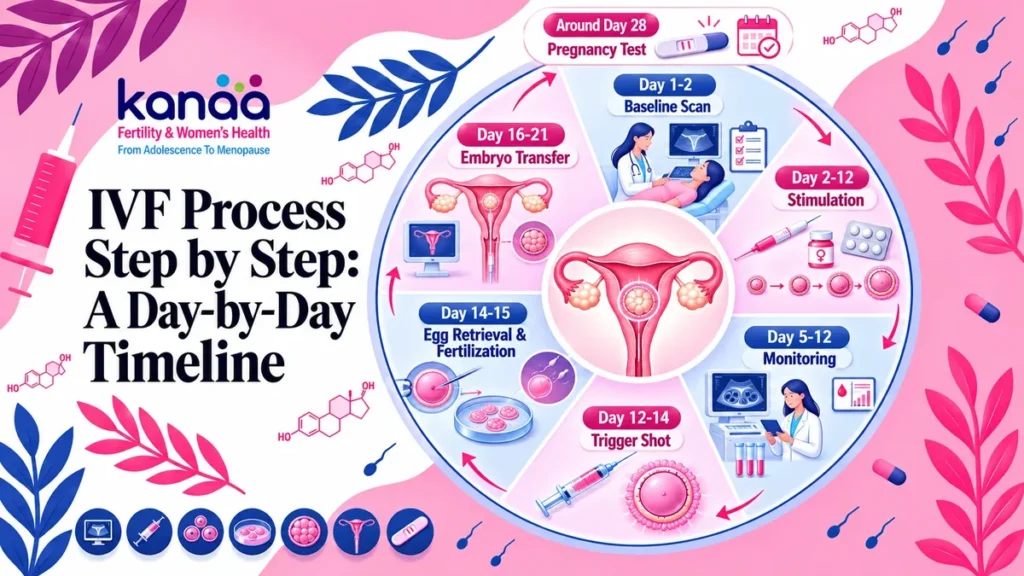
An IVF cycle usually takes about four to six weeks from the first stimulation injection to the pregnancy test, plus two to four weeks of tests and planning beforehand. The main steps are ovarian stimulation, the trigger injection, egg collection, fertilisation in the laboratory, embryo culture, embryo transfer and the two-week wait before a blood test.
Starting IVF can feel overwhelming, mostly because the process is unfamiliar. Knowing what happens on each day, how many visits to expect and what you will be asked to do makes the cycle far easier to plan around work and family. This guide follows a typical IVF cycle from the first consultation to the pregnancy test. Your own schedule will depend on the protocol your doctor chooses for you.

How long does IVF take from start to finish?
A typical timeline looks like this:
| Stage | Typical timing | What happens | Clinic visits |
|---|---|---|---|
| Consultation and tests | 2 to 4 weeks before the cycle | History, tests for both partners, plan | 2 to 3 |
| Ovarian stimulation | About 8 to 14 days | Daily injections, scans and blood tests | 3 to 5 |
| Trigger injection | One evening | Final egg maturation | None, taken at home |
| Egg collection | About 34 to 36 hours after trigger | Short procedure under sedation | 1 |
| Fertilisation | Day 0 to day 1 | IVF or ICSI in the laboratory | None |
| Embryo culture | Day 1 to day 5 or 6 | Embryos grow and are graded | None (phone updates) |
| Embryo transfer | Day 3 or day 5, or a later frozen cycle | Embryo placed in the uterus | 1 |
| Two-week wait | About 9 to 14 days after transfer | Progesterone support | Usually none |
| Pregnancy blood test | End of the wait | Beta hCG blood test | 1 |
If embryos are frozen and transferred in a later cycle, add roughly four to six weeks for the frozen embryo transfer.
Before the cycle: consultation and tests
Every IVF cycle begins with a plan. At your first visits, the doctor reviews the history of both partners and any earlier treatment, and arranges tests. These usually include:
- For the woman: AMH and other hormone tests, thyroid tests, a pelvic ultrasound with an antral follicle count, and infection screening
- For the man: a semen analysis and infection screening
- For both: blood group and any tests suggested by your history
Read more about fertility tests for couples and what a semen analysis report shows.
Once the results are in, your doctor chooses a stimulation protocol. The two most common are the antagonist protocol, which is shorter, and the long agonist protocol, which begins with medicines in the previous cycle. Some women are given a contraceptive pill or other medicine beforehand to help schedule the cycle. You will also sign consent forms, which is a legal requirement in India under the ART (Regulation) Act, 2021.
Ovarian stimulation (about 8 to 14 days)
In a natural cycle, the body usually matures one egg. IVF aims to collect several eggs, because not every egg will fertilise or grow into a healthy embryo.
What you do
Stimulation usually starts on day 2 or 3 of your period. You take daily hormone injections, usually under the skin of the abdomen. The nurse teaches you or your partner how to give them at home. After a few days, a second medicine is added in many protocols to stop the body releasing eggs too early. Our guide to IVF injections and medications explains each one.
What the clinic does
You visit every two to three days for a transvaginal ultrasound and sometimes a blood test. The scans measure the growing follicles, the fluid-filled sacs that contain the eggs. Your doctor may adjust the medicine based on how you respond.
How you may feel
Mild bloating, breast tenderness, tiredness and mood changes are common as the ovaries enlarge. Tell the clinic straight away if you have severe abdominal pain, marked swelling, vomiting or breathlessness.
The trigger injection
When enough follicles reach the right size, you are given a trigger injection. This completes the final maturation of the eggs. Timing is critical: egg collection is planned for about 34 to 36 hours later, so the injection must be taken at the exact time the clinic gives you. Set an alarm and confirm the time with the nurse.
Egg collection day
Egg collection, also called oocyte retrieval, is a short day-care procedure.
- You will be asked not to eat or drink for several hours beforehand.
- You receive sedation or light anaesthesia, so you should not feel pain during the procedure.
- A thin needle guided by ultrasound passes through the vaginal wall into each follicle, and the fluid is gently drawn out.
- The procedure usually takes 15 to 30 minutes.
- You rest for a couple of hours and go home the same day with someone to accompany you.
Mild cramps and light spotting afterwards are common. Most women return to normal activity the next day.
On the same day, the male partner provides a semen sample at the clinic, or a frozen or surgically retrieved sample is prepared. See sperm retrieval procedures if sperm are not present in the ejaculate.
Fertilisation: IVF or ICSI (day 0 to day 1)
In the laboratory, the embryologist checks how many eggs are mature. Fertilisation is then done in one of two ways:
- Conventional IVF: each egg is placed with prepared sperm, and fertilisation happens naturally in the dish.
- ICSI: a single sperm is injected into each mature egg. This is used when sperm count or movement is low, or when fertilisation was poor in an earlier cycle. See ICSI.
The next morning, the embryologist checks for signs of normal fertilisation. You will usually get a call with the number of fertilised eggs.
Embryo culture: day 1 to day 5
Fertilised eggs are now embryos, and they grow in an incubator that controls temperature and gases.
- Day 2 to 3: the embryo divides into roughly 4 to 8 cells.
- Day 5 to 6: a healthy embryo may become a blastocyst, with an inner group of cells that forms the baby and an outer layer that forms the placenta.
Not every embryo continues to grow, and this is a normal part of the process. Embryologists grade embryos to help choose the one with the best chance of implanting. Read embryo grading: day 3 vs day 5 and blastocyst culture.
If PGT-A testing is part of your plan, a few cells are taken from each blastocyst on day 5 or 6 and the embryos are frozen while results are awaited. See PGT-A testing.
Embryo transfer: fresh or frozen
Fresh transfer
In a fresh transfer, an embryo is placed in the uterus on day 3 or day 5 of the same cycle. The transfer is quick and usually painless, much like a routine examination. A thin, soft catheter passes through the cervix under ultrasound guidance. No anaesthesia is needed. You may be asked to come with a comfortably full bladder to help the scan.
Frozen transfer
Sometimes your doctor advises freezing all embryos and transferring one in a later cycle. Common reasons include a high risk of ovarian hyperstimulation, a lining that is not ready, PGT-A testing or a planned ERA test. Read about frozen embryo transfer, embryo freezing and the ERA test.
Remaining good-quality embryos can be frozen for future use.
How many embryos are transferred?
Most clinics now advise transferring a single embryo, because transferring more raises the chance of twins, which carries higher risks for mother and babies. The ART (Regulation) Act, 2021 also sets limits on the number transferred.
The two-week wait
After transfer, you take progesterone support, usually as vaginal gels or tablets, injections or oral tablets, to help prepare the lining for implantation. The wait until the pregnancy test is often the hardest part emotionally.
During this time:
- Continue all medicines exactly as prescribed.
- Normal daily activity is generally fine. Strict bed rest is not needed.
- Avoid home pregnancy tests too early. Trigger and support medicines can affect the result.
- Light spotting can happen and does not always mean the cycle has failed. Call the clinic if you are worried.
Support from your partner, family or a counsellor can help. See emotional support during fertility treatment.
Pregnancy test and next steps
About 9 to 14 days after transfer, depending on the embryo’s stage, you have a blood test for the pregnancy hormone beta hCG. If the result is positive, a repeat test and an early ultrasound follow. Your doctor will tell you how long to continue support medicines.
If the test is negative, your doctor will review the cycle with you. Many couples have frozen embryos for another transfer. Read failed IVF: common reasons and next steps.
What can change your timeline?
- Protocol: long protocols begin earlier than antagonist protocols.
- Your response: stimulation may be extended or adjusted.
- Freeze-all decisions: transfer moves to a later cycle.
- Genetic testing: PGT-A results take time.
- Health reasons: risk of ovarian hyperstimulation, illness or a lining that is not ready.
- Personal reasons: travel, festivals or work commitments, which the team can sometimes plan around.
How to prepare for an IVF cycle
- Keep a calendar of scan dates and injection times.
- Plan leave around egg collection day and the transfer day.
- Store medicines exactly as instructed, some in the refrigerator.
- Eat regular balanced meals, stay hydrated and keep up gentle exercise.
- Stop smoking and avoid alcohol. Ask your doctor before taking any supplement.
- Bring your partner to key appointments if you can.
The male partner’s role at each stage
IVF is often described as a treatment for women, but the male partner has a clear part to play at every stage.
- Before the cycle: a semen analysis and infection screening. If the result is abnormal, a repeat test or a male fertility assessment may be advised before the cycle starts.
- During stimulation: keep up healthy habits, since sperm take about two to three months to develop. Avoid smoking, alcohol and heat exposure such as hot tubs. Your doctor may advise a short period of abstinence before collection day, usually two to five days.
- Egg collection day: provide a sample at the clinic in a private room. If you are anxious about producing a sample on the day, tell the team early. A sample can often be frozen in advance as a backup.
- Through the two-week wait: emotional support matters as much as medical care. Attend the transfer and the results appointment if you can.
Common worries during an IVF cycle
- “I have fewer follicles than I expected.” Response varies between women and between cycles. Your doctor will explain whether to continue, adjust or change the plan.
- “Not all my eggs fertilised.” This is common. Not every egg collected is mature, and not every mature egg fertilises.
- “My embryos stopped growing.” Some embryos stop developing in the laboratory. This often reflects the embryo itself rather than anything you did.
- “I had spotting after transfer.” Light spotting can occur and does not always mean the cycle has failed. Keep taking your medicines and call the clinic.
Frequently asked questions
How long does IVF take?
One IVF cycle usually takes about four to six weeks from the start of stimulation to the pregnancy test. Tests and planning before the cycle add two to four weeks, and a frozen transfer adds about another month.
How many clinic visits does IVF need?
Most women need about six to ten visits in one cycle: planning visits, three to five monitoring scans, egg collection, embryo transfer and the pregnancy test.
Is egg collection painful?
Egg collection is done under sedation or light anaesthesia, so you should not feel pain during it. Mild cramps and spotting for a day or two afterwards are common.
Can I work during IVF?
Most women continue working. Plan a day off for egg collection and possibly the day after, and allow time for morning scans during stimulation.
Do I need bed rest after embryo transfer?
No. Research has not shown that bed rest helps. Normal light activity is generally fine.
What happens to extra embryos?
Good-quality extra embryos can be frozen and stored for a future transfer, with your written consent.
Plan your IVF cycle with Kanaa
Kanaa Fertility Centre offers IVF and ICSI with embryo culture, freezing and testing at our centres in KK Nagar and Mylapore, Chennai. Our team will explain your protocol, give you a written calendar and stay with you through each step. Book a consultation or read more about IVF treatment in Chennai.
This article is for general information. Every couple is different, and your doctor will recommend tests and treatment based on your individual evaluation.