
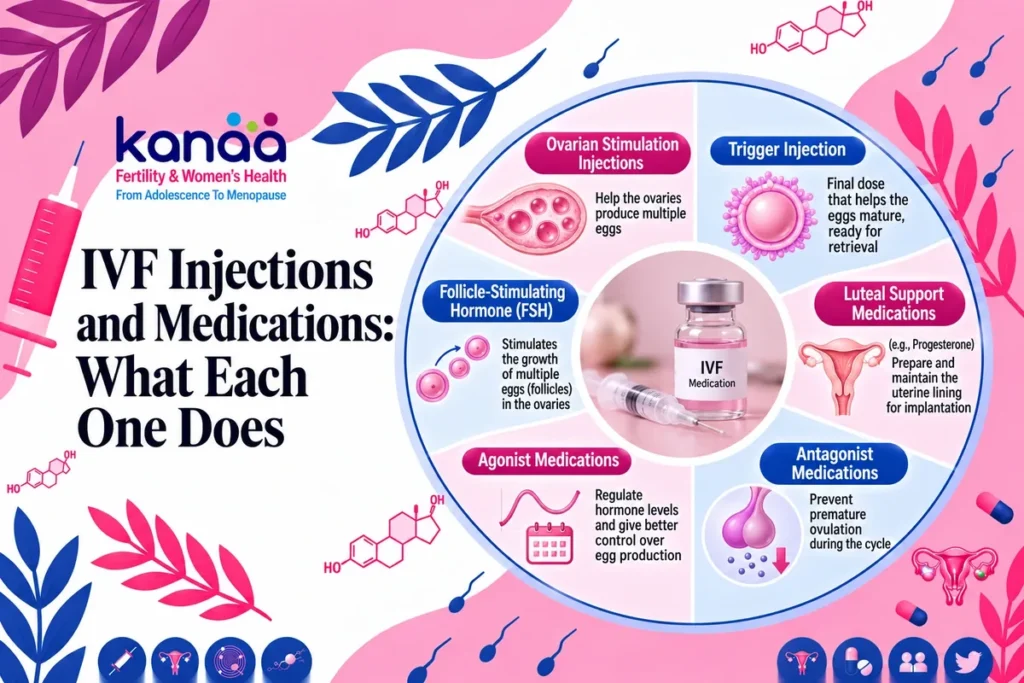
IVF uses a sequence of medicines with different jobs: stimulation injections help several eggs grow, a second medicine stops the body releasing those eggs too early, a trigger injection completes egg maturation, and progesterone supports the uterine lining after embryo transfer. Your doctor chooses the exact medicines and doses for your body, and the clinic shows you how to give each injection at home.
For many people, the injections are the part of IVF they worry about most. The names are unfamiliar, the schedule is precise and it is natural to wonder whether the medicines are safe. This guide groups IVF medicines by what they do and when you take them, so that the plan your doctor gives you makes sense. It does not replace your prescription. Always follow the instructions from your own clinic, and never change a dose on your own.
Why does IVF need medication?
In a natural cycle, the brain releases hormones that cause one egg to mature and be released each month. IVF aims to collect several mature eggs in one cycle, because not every egg will fertilise or grow into a healthy embryo. Medicines make this possible by:
- Encouraging several follicles to grow at the same time
- Preventing the body from releasing the eggs before collection
- Timing the final maturation of the eggs precisely
- Preparing and supporting the uterine lining for implantation
Each of these steps needs a different type of medicine. You can see where each fits in the cycle in our IVF process step by step guide.
Medicines at a glance
| Medicine group | Purpose | When in the cycle | How it is usually given |
|---|---|---|---|
| Pre-cycle medicines (in some protocols) | Schedule the cycle or prepare the ovaries | Before stimulation | Tablets or injection |
| Stimulation injections (gonadotropins) | Help several eggs grow | About 8 to 14 days from day 2 or 3 of the period | Daily injection under the skin |
| Medicines that prevent early ovulation | Stop eggs being released too soon | During stimulation, or from the previous cycle in long protocols | Daily injection under the skin |
| Trigger injection | Final egg maturation | Once, about 34 to 36 hours before egg collection | Single injection |
| Luteal support (progesterone) | Support the lining for implantation | From egg collection or transfer until the pregnancy test, longer if pregnant | Vaginal gel or tablet, injection or oral |
| Oestrogen (frozen transfer cycles) | Build up the lining | Before a frozen embryo transfer | Tablets, patches or gel |
Stimulation injections: helping several eggs grow
The main IVF injections are called gonadotropins. They contain follicle stimulating hormone (FSH), sometimes combined with luteinising hormone (LH) activity. These are the same hormones the body makes naturally, given in larger amounts to encourage several follicles to develop. This is why people often search for an “egg growth injection”.
How the dose is chosen
Your doctor chooses the starting dose based on your age, AMH level, antral follicle count, weight and any response in earlier cycles. During stimulation, scans every two to three days show how the follicles are growing, and the dose may be adjusted. This is why it is important to attend every monitoring visit. Read what is the ovarian reserve.
What it feels like
Most injections use a fine needle or a pre-filled pen and are given under the skin of the abdomen. Mild stinging, redness or a small bruise at the injection site is common. As the ovaries enlarge, many women feel bloated or a little heavy in the lower abdomen.
Medicines that prevent early ovulation
When several follicles grow, the body may try to release the eggs before collection. A second medicine prevents this. There are two main types:
- GnRH antagonists: added a few days into stimulation and taken daily until the trigger. This is used in the shorter “antagonist protocol”.
- GnRH agonists: started earlier, often in the previous cycle, to quieten the natural hormone signals before stimulation begins. This is used in the “long protocol”. Read about GnRH agonists.
Your doctor chooses the protocol that best suits your tests and history. Both approaches are widely used.
The trigger injection
When the scans show that enough follicles have reached the right size, you take a single trigger injection. It completes the final maturation of the eggs so that they are ready for collection. Two types of trigger are used: one based on hCG and one based on a GnRH agonist. A GnRH agonist trigger may be chosen when there is a higher risk of ovarian hyperstimulation.
Timing is critical. Egg collection is usually planned about 34 to 36 hours after the trigger. Take it at the exact time your clinic gives you, set more than one alarm and confirm with the nurse that you have taken it.
Support after egg collection and transfer: progesterone
After egg collection, the body’s own progesterone production may not be enough to support the lining. Progesterone is therefore given from around the time of egg collection or transfer. It can be given as:
- Vaginal gel, tablets or pessaries
- Injections
- Oral tablets in some cases
Progesterone usually continues until the pregnancy test and, if the test is positive, for some weeks into early pregnancy as advised by your doctor. Do not stop it on your own, even if you have spotting. Call the clinic instead.
In a frozen embryo transfer cycle, oestrogen may be given first to build up the lining, followed by progesterone. Read about frozen embryo transfer.
Other medicines you may hear about
- Oral ovulation medicines: tablets that help the ovaries release an egg are mainly used in ovulation induction and IUI rather than standard IVF. Some mild stimulation IVF protocols use them. See ovulation induction.
- The contraceptive pill: sometimes used before IVF to plan the start date of a cycle.
- Antibiotics or other medicines: occasionally given around egg collection or for specific conditions.
- Supplements: such as folic acid. Ask your doctor before taking any other supplement during IVF.
Side effects and when to call the clinic
Most side effects of IVF medicines are mild and short-lived:
- Bloating and mild abdominal discomfort
- Breast tenderness
- Headache
- Tiredness
- Mood swings or feeling emotional
- Redness, itching or bruising where the injection was given
Ovarian hyperstimulation syndrome (OHSS)
OHSS is an uncommon but important complication in which the ovaries overreact to stimulation. Your doctor monitors you to reduce the risk and may change the trigger or freeze all embryos if the risk is high. Call the clinic straight away if you have:
- Severe or worsening abdominal pain or swelling
- Nausea or vomiting that does not settle
- Rapid weight gain over one or two days
- Passing much less urine than usual
- Shortness of breath
Giving injections at home
Most IVF injections are given at home by you or your partner after the nurse shows you how. These tips help:
- Storage: follow the storage instructions on each medicine. Some must be kept in the refrigerator, others at room temperature. Do not freeze them.
- Timing: give the injection at the same time each day, or at the exact time given for the trigger.
- Preparation: wash your hands, clean the skin and check the pen or syringe before each dose.
- Site: use the area of the abdomen your nurse shows you, and change the spot each day.
- Disposal: put used needles in a hard container, never in household waste. Ask the clinic how to dispose of it.
- Record: keep a simple chart of each dose and time.
- Ask early: if you miss a dose or make a mistake, call the clinic right away rather than doubling up.
If you are nervous about needles, tell the team. Many clinics can arrange for a nurse to give the first few injections.
Are IVF medicines safe?
IVF medicines have been used for decades and are considered safe when prescribed and monitored by a fertility specialist. Large studies have not shown a clear link between fertility medicines and long-term health problems, although research continues. Your doctor will check your health before treatment and monitor you throughout the cycle. Share your full medical history and every medicine or supplement you take.
Daily life while taking IVF medicines
Most people continue their normal routine during IVF, with a few adjustments:
- Work: most women keep working. Plan for morning scans every few days and a day off for egg collection.
- Exercise: gentle walking and light activity are usually fine. As the ovaries enlarge during stimulation, avoid high-impact exercise, heavy lifting and sudden twisting movements, which can cause discomfort or, rarely, twisting of an enlarged ovary.
- Food and fluids: eat regular, balanced meals and drink enough water. Some clinics suggest extra protein and fluids if bloating develops.
- Alcohol, smoking and caffeine: avoid alcohol and smoking completely. Keep caffeine moderate.
- Other medicines: do not start any new medicine, herbal product or supplement without checking with the fertility team, including pain relievers.
- Intercourse: your doctor will advise whether to avoid intercourse during stimulation and around egg collection.
- Emotions: hormone changes, injections and waiting can feel overwhelming. Share how you feel with your partner, and ask about counselling and emotional support.
Keep the clinic’s contact number saved on your phone, and ask questions whenever something is unclear. No question about your medicines is too small.
Questions to ask your doctor about your medicines
- Which protocol am I on, and why?
- What does each medicine in my plan do?
- How and where should I store each one?
- What should I do if I miss a dose?
- Which side effects are expected, and which need a call?
- How long will I continue progesterone?
Frequently asked questions
What injections are used in IVF?
IVF usually uses stimulation injections (gonadotropins) to grow several eggs, an injection to prevent early ovulation (a GnRH antagonist or agonist), a single trigger injection to mature the eggs, and progesterone support after egg collection or transfer.
Are IVF injections painful?
Most IVF injections use very fine needles or pens and cause only mild stinging. Some progesterone injections given into the muscle can be more uncomfortable. Changing the injection site helps.
How many days of injections are needed for IVF?
Stimulation injections usually last about 8 to 14 days, followed by a single trigger injection. Long protocols start some medicines earlier. Progesterone continues after transfer.
Can I travel during IVF injections?
Short trips are sometimes possible, but you need to attend monitoring scans every few days and keep medicines at the right temperature. Discuss travel with the clinic before starting.
Do IVF medicines cause weight gain?
Some women notice bloating and slight weight gain from fluid during stimulation. This usually settles after the cycle. Rapid weight gain over a day or two should be reported, as it can be a sign of OHSS.
Do IVF medicines cause long-term harm?
Current evidence has not shown a clear link between IVF medicines and long-term health problems. Your doctor will discuss any specific concerns related to your health history.
Ask our IVF team about your protocol
Kanaa Fertility Centre plans each IVF protocol around your tests and monitors every cycle closely at our centres in KK Nagar and Mylapore, Chennai. Our nurses teach every patient how to take their medicines safely at home. Book a consultation or read more about IVF treatment in Chennai.
This article is for general information. Every couple is different, and your doctor will recommend tests and treatment based on your individual evaluation.