
Embryo Freezing
Preserving your embryos today, for possible use in the future — whether from an IVF/ICSI cycle or ahead of fertility-affecting treatment. Available at our KK Nagar and Mylapore clinics in Chennai.
Book Your Consultation
Talk to a Kanaa fertility specialist. We will call you back.
Request a CallbackYour enquiry is private and handled with care by our medical team.
Embryo freezing (cryopreservation) at Kanaa Fertility preserves fertilised embryos — formed during an IVF/ICSI cycle — using a fast-freezing technique called vitrification, for use in a future cycle. Two clinics in KK Nagar & Mylapore, with in-person & online consultations.
Embryo Freezing — Preserving Your Options
Embryo freezing (cryopreservation) is the process of freezing fertilised embryos, created through IVF or ICSI, by a technique called vitrification for long-term storage and future use.
Since typically only 2–3 embryos are transferred in a single cycle, any additional good-quality embryos can be frozen and stored for future attempts, without needing to repeat the full stimulation and retrieval process.
Formed, Then Frozen
Embryos are created in an IVF/ICSI cycle, then frozen by vitrification within days of fertilisation.
No Repeat Stimulation Needed
Frozen embryos can be used in a future cycle without another egg retrieval.
Proven & Widely Used
Vitrification has been used safely since the 1980s with strong success rates.
Who Considers Embryo Freezing?
Embryo freezing is a routine part of many IVF/ICSI cycles — and is also chosen for specific medical or personal reasons.
Surplus Embryos From IVF/ICSI
To avoid the risk of OHSS, extra good-quality embryos from a stimulation cycle are frozen instead of all being transferred at once.
Before Cancer Treatment or Ovary-Affecting Surgery
Couples may freeze embryos ahead of treatment that could affect future fertility.
Postponing Childbearing
Married couples may choose to freeze embryos to delay starting a family for personal reasons.
Genetic Testing Before Transfer
Embryos needing genetic testing prior to use are frozen while results are awaited.
The Embryo Freezing Process, Step by Step
What's Involved
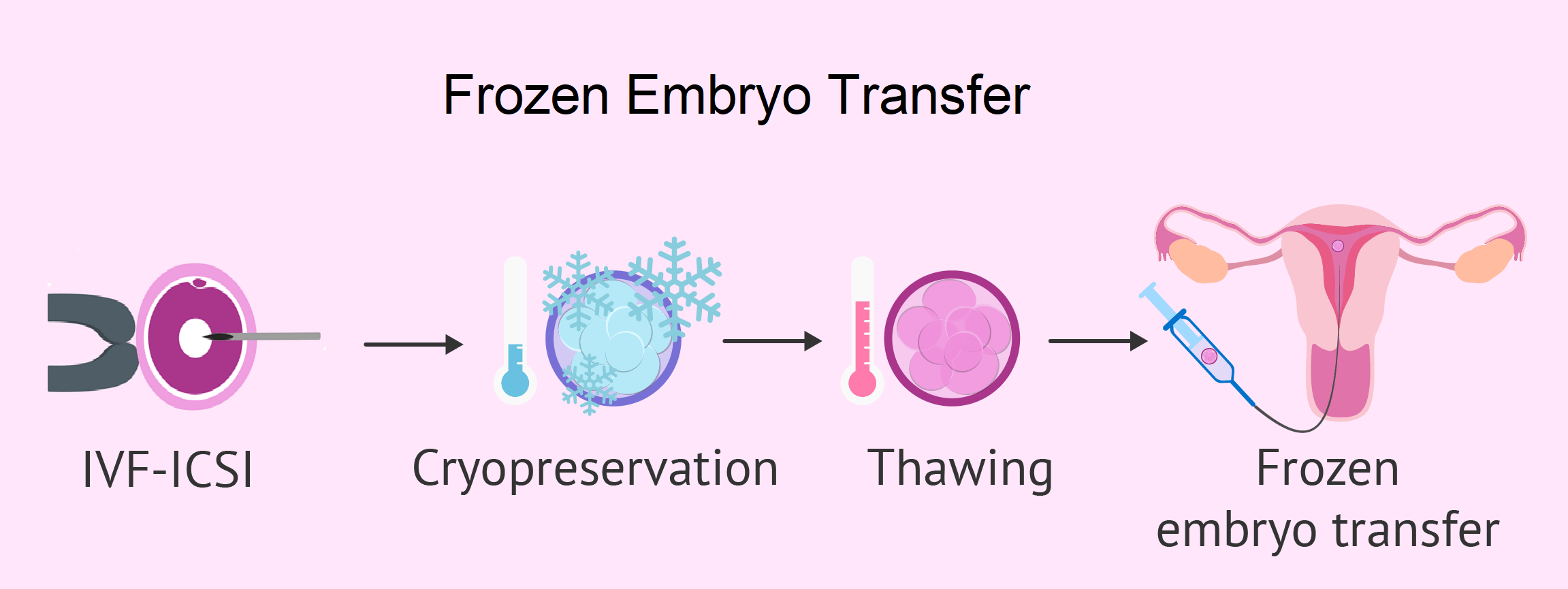
A typical cycle involves a stimulation phase (if applicable), egg retrieval and fertilisation, embryo culture, and vitrification for storage. A future frozen embryo transfer involves lining monitoring, progesterone support, and the transfer itself. Starting price to be confirmed by the clinic.
About Your Chances of Success
Success with frozen embryo transfer depends on individual factors, including embryo quality at the time of freezing, the woman's age, and endometrial receptiveness at the time of transfer. Your specialist can discuss what's realistic for your specific situation.
What Affects Your Chances of Success
Embryo quality and grading, the age of the woman at the time the eggs were collected, and the condition of the uterine lining at transfer.
Risks & What to Expect
Common and Usually Mild
- Theoretical risk of embryos not surviving the thaw (uncommon with vitrification and good-quality embryos).
- Mild bloating or discomfort during the stimulation phase, if applicable.
Less Common, Worth Knowing
- Ovarian Hyperstimulation Syndrome (OHSS) — Pending a doctor's exact wording before publishing — this line was added by the drafting process, not sourced from the live page.
- Not All Embryos Survive the Freeze-Thaw Process — Some loss of embryos is expected and normal, though vitrification has significantly reduced this risk compared to older slow-freezing methods.
Your care team monitors embryo quality and survival closely at every stage, from freezing through to thaw.
Legal & Regulatory Considerations
Consent from both partners is required for embryo freezing and storage, and specific requirements apply under India's ART (Regulation) Act — including maximum storage duration and consent renewal. This should be discussed directly with your specialist.
Related Options to Consider
Depending on your situation, your specialist may also discuss egg freezing (if you don't yet have a partner or are not ready to fertilise) or sperm freezing for the male partner.
Why Choose Kanaa Fertility?
Experienced Fertility Specialists
A skilled team specialised in reproductive medicine.
Careful, Close Monitoring
Scans and dose adjustments guided at every step.
Personalised Protocols
Your treatment designed around your body and diagnosis.
Compassionate, Patient-First Care
Support at every step of your journey.
Two Convenient Locations in Chennai
KK Nagar & Mylapore, with flexible scheduling.
Questions to Ask Your Doctor
- Is embryo freezing right for my situation?
- How many embryos are likely to be suitable for freezing?
- What are my chances of a successful pregnancy with a frozen embryo transfer?
- What happens to my embryos if I no longer wish to continue storing them?
- Is consent from both partners required, and for how long is storage valid under Indian law?
Frequently Asked Questions
Will embryos be damaged during the process of freezing?
Embryo freezing has been in common use since the 1980s and has been proven safe and effective, especially with vitrification. There is a theoretical risk of embryos being damaged or not surviving when thawed, but since only good-quality embryos are chosen for freezing, this risk is negligible in experienced hands.
How long can embryos be stored in a frozen state?
Pending a doctor's exact wording before publishing — this line was added by the drafting process, not sourced from the live page.
Do frozen embryos give as good success rates as fresh embryos?
Pending a doctor's exact wording before publishing — this line was added by the drafting process, not sourced from the live page.
What can I do if I no longer wish to continue storing my embryos?
Pending a doctor's exact wording before publishing — this line was added by the drafting process, not sourced from the live page.
Is consent of both partners needed for freezing?
Yes, informed consent from both partners is required before embryos can be frozen and stored, in line with ART Act requirements.
What is the difference between embryo freezing and egg freezing?
Embryo freezing preserves fertilised embryos (formed from an egg and sperm), while egg freezing preserves unfertilised eggs. Embryo freezing requires a partner or donor sperm at the time of freezing; egg freezing does not.
Can I use frozen embryos in a natural cycle, or do I need medication?
Pending a doctor's exact wording before publishing — this line was added by the drafting process, not sourced from the live page.
Your Embryos, Your Timeline
Book a consultation about embryo freezing at Kanaa Fertility, Chennai — KK Nagar & Mylapore.