
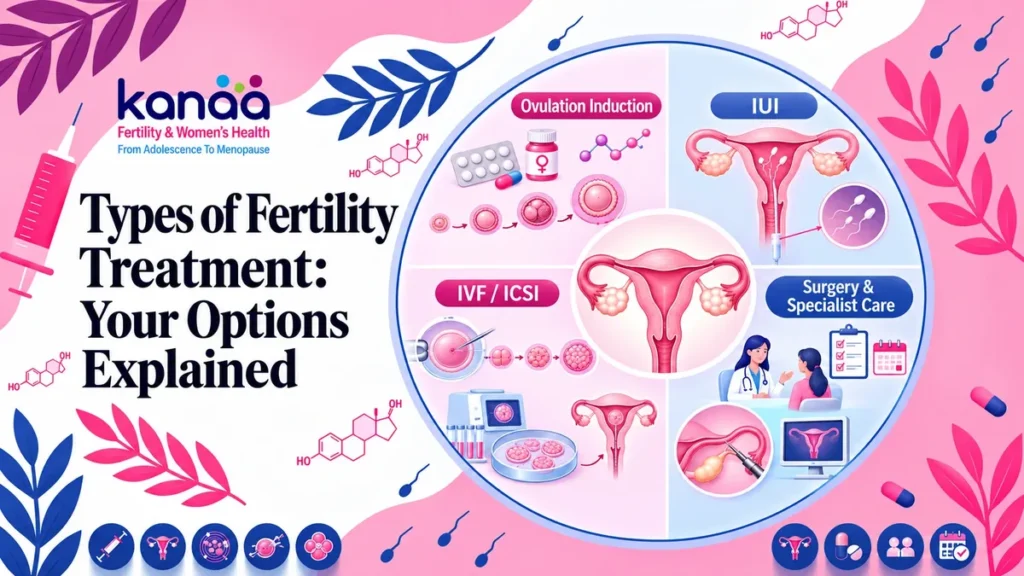
There are several types of fertility treatment, and most couples do not need the most complex one. The main options are lifestyle and timing guidance, ovulation induction, intrauterine insemination (IUI), in vitro fertilisation (IVF), intracytoplasmic sperm injection (ICSI), fertility surgery, male fertility treatment, donor programmes and fertility preservation. The right choice depends on what tests show for both partners, the woman’s age and how long you have been trying.
When pregnancy does not happen as expected, it is natural to search for answers and to feel that IVF is the only way forward. In reality, fertility care works like a ladder. Doctors usually begin with the simplest effective step and move to more involved treatment only when it is needed. This guide explains each option in plain language, who it may suit and what it involves, so that you can walk into your consultation with clear questions.
What counts as fertility treatment?
Fertility treatment is any medical care that helps a couple conceive when pregnancy has not happened naturally within the expected time. It can be as simple as correcting a thyroid problem or timing intercourse around ovulation, or as involved as growing embryos in a laboratory.
Treatment is aimed at the cause wherever possible. Common causes include problems with ovulation, blocked or damaged fallopian tubes, conditions of the uterus such as polyps or fibroids, endometriosis, reduced egg reserve and changes in sperm count, movement or shape. In some couples more than one factor is present, and in some no clear cause is found even after full testing. This is called unexplained infertility, and effective options are still available.
How doctors decide which treatment to try first
No two couples are the same, so the first step is always a proper assessment of both partners. Your doctor will usually consider:
- Test results for both partners. Hormone tests, an ultrasound and a tube test for the woman, and a semen analysis for the man. Read about our fertility tests for couples.
- The woman’s age. Egg numbers and quality fall with age, so time matters more after 35.
- How long you have been trying.
- Your medical history. Previous surgery, pregnancies, miscarriages, long-term conditions and medicines.
- Your preferences. Cost, time, comfort with procedures and personal or religious views all count.
Tests come before treatment
Starting treatment without tests can waste months. A semen analysis, for example, takes little time but can change the plan completely. If you have not yet been assessed, a first fertility consultation is the right starting point.
Age and time trying
Most guidelines suggest seeing a specialist after 12 months of trying if the woman is under 35, after 6 months if she is 35 or older, and sooner if periods are irregular or there is a known condition.
Treatments that support natural conception
Timing and lifestyle guidance
For some couples, especially those who have not been trying for long and whose tests are normal, the first step is guidance rather than medicine. This may include learning to identify the fertile window, adjusting frequency of intercourse, managing weight, stopping smoking, reducing alcohol and treating conditions such as thyroid imbalance. Our guide on how to tell when you are ovulating explains the fertile window in detail.
Ovulation induction
If a woman does not release an egg regularly, a condition called anovulation, medicines can help the ovaries produce and release an egg. This is called ovulation induction. It is often used for women with polycystic ovary syndrome (PCOS) or irregular cycles. Treatment is monitored with ultrasound scans, often called a follicular study, to check how the egg is growing and to time intercourse or insemination. Learn more about ovulation induction at Kanaa.
Who it may suit: women with irregular or absent ovulation, open fallopian tubes and a partner with a normal or near-normal semen analysis.
Intrauterine insemination (IUI)
IUI places specially prepared sperm directly into the uterus around the time of ovulation. The sperm are washed and concentrated in the laboratory, and a thin, soft tube is used to place them. The procedure takes a few minutes and usually feels like a routine examination.
IUI can be done in a natural cycle or combined with ovulation induction. It shortens the distance sperm need to travel and places more healthy sperm near the egg.
Who it may suit:
- Couples with mild changes in sperm count or movement
- Women with ovulation problems who have open tubes
- Unexplained infertility in younger women
- Couples who find timed intercourse difficult
- Couples using donor sperm
IUI needs at least one open fallopian tube. Read more about IUI treatment in Chennai and how it compares in our guide to IVF vs IUI.
IVF and ICSI
In vitro fertilisation (IVF)
In IVF, the ovaries are stimulated with medicines to grow several eggs. The eggs are collected in a short procedure under sedation and mixed with sperm in the laboratory. The resulting embryos are grown for a few days, and one embryo is placed in the uterus. Remaining good-quality embryos can be frozen for later use.
Who it may suit:
- Blocked or damaged fallopian tubes
- Moderate to severe endometriosis
- Reduced ovarian reserve
- Unexplained infertility after other options
- Couples where IUI has not worked
- Some couples who need genetic testing of embryos
IVF is a multi-week process. Our step-by-step IVF timeline walks through every stage, and our IVF treatment page explains how we plan it at Kanaa.
Intracytoplasmic sperm injection (ICSI)
ICSI is a form of IVF in which an embryologist injects a single sperm directly into each mature egg. It is mainly used when sperm count, movement or shape is significantly reduced, when sperm have been retrieved surgically, or when fertilisation did not happen in an earlier IVF cycle. Learn more about ICSI.
Laboratory add-ons
Some IVF cycles include additional techniques. These are not needed by everyone and are discussed case by case:
- Blastocyst culture: growing embryos to day 5 or 6 before transfer. See blastocyst culture.
- PGT-A: checking embryos for the correct number of chromosomes. See PGT-A testing.
- ERA test: checking the timing of the uterine lining for transfer. See ERA test.
- Laser assisted hatching: thinning the outer shell of the embryo. See laser assisted hatching.
- Embryo freezing: storing embryos for future transfer. See embryo freezing.
Fertility surgery
Surgery is used when a physical problem in the uterus, tubes or pelvis is affecting fertility. Modern fertility surgery is usually minimally invasive.
Hysteroscopy
A thin camera is passed through the cervix to look inside the uterus. It can find and treat polyps, fibroids that grow into the cavity, scar tissue and a uterine septum, with no cuts on the abdomen. See hysteroscopy.
Laparoscopy
Keyhole surgery through small cuts in the abdomen lets the surgeon see the outside of the uterus, tubes and ovaries. It is used to diagnose and treat endometriosis, ovarian cysts, adhesions and some tubal problems. See laparoscopy.
Your doctor may suggest surgery before other treatment, or decide that IVF is the better route. For example, badly damaged tubes may be bypassed by IVF rather than repaired.
Treatments for male infertility
A male factor is present in a large share of couples who have difficulty conceiving, either alone or together with a female factor. Treatment depends on the cause:
- Lifestyle changes: stopping smoking, reducing alcohol, managing weight and avoiding heat exposure. See how to improve sperm health naturally.
- Treating the cause: hormone problems, infections or a varicocele (enlarged veins in the scrotum) may be treatable.
- IUI or ICSI: depending on how much the semen analysis is affected.
- Surgical sperm retrieval: when there are no sperm in the ejaculate, sperm may be collected directly from the testis or epididymis. See sperm retrieval procedures and TESA.
If you are unsure whether a male factor is involved, start with a male fertility assessment and read our guide to the signs of infertility in men.
Donor programmes and surrogacy
Donor sperm, eggs and embryos
When a couple’s own sperm or eggs cannot be used, donor gametes may make pregnancy possible. Donor sperm may be used with IUI or IVF. Donor eggs are used with IVF when a woman’s ovaries cannot produce suitable eggs. Donor embryos are another option for some couples. In India, donation is regulated under the Assisted Reproductive Technology (Regulation) Act, 2021, and donors are screened through registered ART banks. Learn more about our donor sperm, donor egg and donor embryo programmes.
Surrogacy
Surrogacy is a medical option for women who cannot carry a pregnancy safely, for example because of the absence of a uterus or a serious medical condition. In India, only altruistic surrogacy is permitted under the Surrogacy (Regulation) Act, 2021, with strict eligibility rules. See surrogacy.
Fertility preservation
Fertility preservation means freezing eggs, sperm or embryos for later use. It may be considered before cancer treatment, before surgery that could affect the ovaries or testes, or by people who want to delay pregnancy. Frozen embryos from an IVF cycle can also be stored for a future pregnancy. See embryo freezing.
Fertility treatments compared
| Treatment | Who it may suit | What it involves | Typical visits |
|---|---|---|---|
| Timing and lifestyle guidance | Short time trying, normal tests | Advice, treating simple causes | One or two |
| Ovulation induction | Irregular or absent ovulation | Tablets or injections with scans | Several per cycle |
| IUI | Mild sperm changes, ovulation problems, unexplained infertility | Washed sperm placed in the uterus | Scans plus insemination |
| IVF | Tubal damage, endometriosis, low egg reserve, failed IUI | Stimulation, egg collection, lab fertilisation, embryo transfer | Many over 4 to 6 weeks |
| ICSI | Significant sperm problems, retrieved sperm | IVF with one sperm injected per egg | As IVF |
| Hysteroscopy or laparoscopy | Uterine or pelvic problems | Day-care or short-stay procedure | Procedure plus follow-up |
| Sperm retrieval | No sperm in ejaculate | Minor surgical procedure, then ICSI | Procedure plus IVF cycle |
| Donor programmes | Own eggs or sperm not usable | Donor gametes with IUI or IVF | As the linked treatment |
| Fertility preservation | Planning for the future | Freezing eggs, sperm or embryos | Varies |
Questions to ask at your consultation
- What do our test results show for each of us?
- Which treatment do you suggest first, and why?
- How many cycles of this treatment would you advise before changing approach?
- What are the risks and side effects?
- What will the full cost include?
- What can we do at home to support treatment?
- Is counselling available? See emotional support during treatment.
Frequently asked questions
Which fertility treatment is best?
There is no single best treatment. The right option is the one that matches the cause found in your tests, the woman’s age and how long you have been trying. Many couples conceive with simpler treatments such as ovulation induction or IUI.
Do we need IVF straight away?
Not usually. IVF is advised straight away only when tests show it is the most suitable option, for example when both tubes are blocked or sperm problems are severe. Otherwise, simpler steps are often tried first.
Can men get fertility treatment too?
Yes. Male infertility can often be improved by treating the cause or lifestyle factors, and when needed, IUI, ICSI or surgical sperm retrieval can help.
How long does fertility treatment take?
It varies. Ovulation induction and IUI work cycle by cycle, roughly a month each. An IVF cycle usually takes 4 to 6 weeks from the start of stimulation to the pregnancy test.
Is fertility treatment painful?
Most steps involve little discomfort, such as blood tests, scans and injections. Procedures like egg collection, hysteroscopy and laparoscopy are done with anaesthesia or sedation.
Can fertility treatment guarantee pregnancy?
No treatment can guarantee pregnancy. Your doctor will explain your realistic chances based on your own results.
Ready to discuss your options?
Kanaa Fertility Centre offers fertility tests, ovulation induction, IUI, IVF, ICSI, fertility surgery, male fertility treatment, donor programmes and fertility preservation at our centres in KK Nagar and Mylapore, Chennai. If you are not sure which option fits, book a consultation with our fertility specialists and start with a clear plan.
This article is for general information. Every couple is different, and your doctor will recommend tests and treatment based on your individual evaluation.