
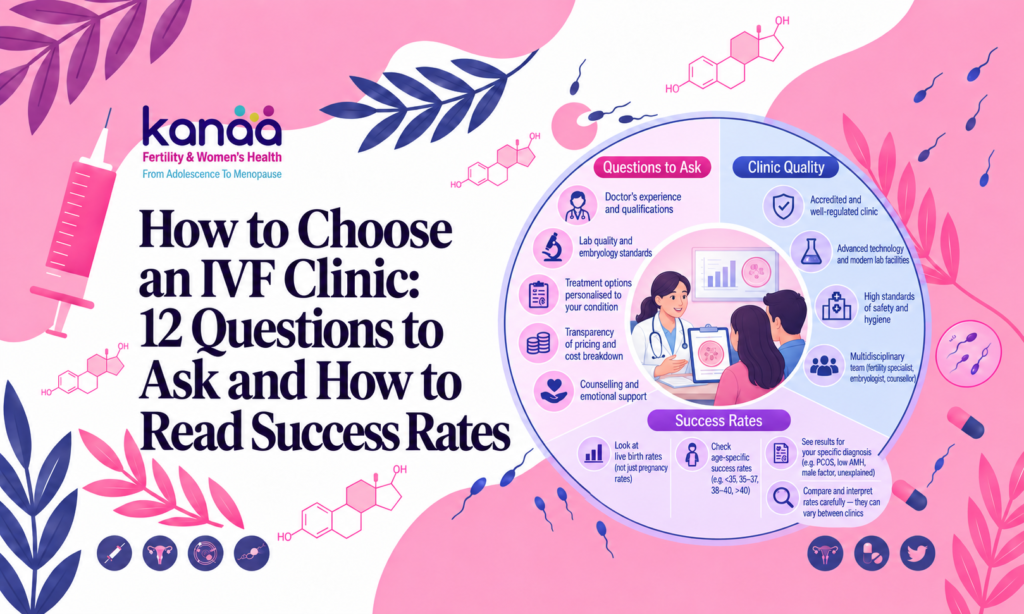
Once you have been advised to consider IVF, one of the first big decisions is where to have treatment. Advertisements, reviews and success-rate claims can make the choice feel confusing, especially when every clinic seems to promise the best results.
This guide gives you a fair, practical way to compare any IVF clinic, including ours. It explains how success rates are really calculated, the questions worth asking at a first consultation, and the warning signs to watch for. The aim is simple: to help you choose a clinic you can trust, with a plan that fits your own medical situation.
Key takeaways: A good IVF clinic combines an experienced medical team, a well-run embryology lab, honest reporting of results, a personalised plan, clear costs and emotional support. Success rates are only comparable when they measure the same outcome, in the same age group, counted the same way. No clinic can guarantee pregnancy.
What Makes a Good IVF Clinic?
A good IVF clinic has qualified fertility specialists, a well-run embryology laboratory, honest and clearly explained success rates, a treatment plan tailored to you, transparent written costs and good emotional support. It should also be registered as required under Indian law and communicate clearly at every stage.
No single factor decides everything. A clinic with impressive technology but poor communication may leave you anxious and unsure, while a warm clinic without strong lab standards may not give you the best chance. You are looking for a balance of medical quality, honesty and care.
How to Read IVF Success Rates
IVF success rates are only meaningful when you know what outcome is being measured, who was included, and how it was counted. Two clinics can report very different numbers for exactly the same results simply by measuring them differently.
Clinical pregnancy rate vs live birth rate
A clinical pregnancy usually means a pregnancy confirmed on ultrasound, for example by seeing a pregnancy sac. A live birth means a baby was born. Because some pregnancies end in miscarriage, the live birth rate is always lower than the clinical pregnancy rate. For patients, the live birth rate is the most meaningful number, because it reflects what you are hoping for.
A positive pregnancy blood test is an even earlier stage. Rates based only on a positive test will look higher again.
Per cycle started vs per embryo transfer
A rate can be calculated per treatment cycle started, per egg collection or per embryo transfer. Not every started cycle reaches embryo transfer. Some are cancelled, and some produce no suitable embryos. A rate per embryo transfer leaves these out, so it usually looks higher than a rate per cycle started. Neither is wrong, but you should compare like with like.
Some clinics also report cumulative rates, which count all transfers from one egg collection, including frozen embryos. These can be useful, but again, only compare them with other cumulative rates.
Why age groups must be compared separately
Age is the strongest single factor in IVF outcomes, because egg quality and number change with age. A clinic that treats mostly younger women will naturally report higher overall rates than one that treats many women over 40. Always look at results for your own age group.
Why small numbers and selected patients can skew rates
A rate based on a small number of patients can swing a lot from year to year. A clinic that treats only patients with a good outlook, or that uses donor eggs in many cycles, may also report higher numbers. Ask whether the rate includes all patients or a selected group, and whether donor-egg cycles are counted separately.
| Metric | What it means | Question to ask the clinic |
|---|---|---|
| Positive pregnancy test rate | A positive blood test after transfer | Do you also report ultrasound-confirmed and live birth rates? |
| Clinical pregnancy rate | Pregnancy confirmed on ultrasound | How many of these continued to a live birth? |
| Live birth rate | A baby born | Is this per cycle started, per egg collection or per transfer? |
| Per embryo transfer | Only cycles that reached transfer | What share of started cycles reached transfer? |
| Cumulative rate | All transfers from one egg collection | Does this include frozen embryo transfers? |
| Age-group results | Results split by the woman’s age | What are the results for women my age? |
12 Questions to Ask Before You Choose
These questions work for any clinic. Bring them to your first consultation, and notice not just the answers but how openly they are given.
About the doctors
- Who will be responsible for my care, and will I see the same doctor through treatment? Continuity helps you build trust and avoid repeating your history.
- What experience does the team have with cases like mine? For example, low ovarian reserve, PCOS, endometriosis, male factor or previous failed cycles.
- Who performs the egg collection and embryo transfer? It is reasonable to know who will be doing each procedure.
About the laboratory
- Who are the embryologists, and can they explain how the lab works? The lab is where eggs are fertilised and embryos grow, so it plays a central role in outcomes.
- How are embryos cultured, frozen and stored? Ask about embryo freezing methods and storage safety. You can read more in our guide to fresh vs frozen embryo transfer.
- Which tests and techniques are available if I need them? For example, ICSI, embryo freezing, or genetic testing of embryos, and when the clinic recommends each.
About the treatment plan
- Why is IVF recommended for me, and are there alternatives? A good clinic explains its reasoning and discusses options such as IUI where appropriate. You may find our guide to how IVF works step by step useful before this conversation.
- What tests will both partners need before starting? Testing both partners avoids surprises later.
- How do you report success rates, and what are the results for patients like me? Use the table above to understand the answer.
About costs
- What does the quoted price include, and what might cost extra? Medicines, embryo freezing, storage, genetic testing and additional transfers are often separate. Ask for a written estimate.
About support and practicalities
- What counselling and emotional support do you offer? IVF can be emotionally demanding for both partners.
- How will you contact me, and whom do I call with an urgent question? Clear communication matters, especially during stimulation and after transfer.
Registration and Regulation of IVF Clinics in India
In India, IVF clinics and gamete banks are regulated under the Assisted Reproductive Technology (Regulation) Act, 2021. Clinics providing IVF are required to be registered under this law, and surrogacy is governed separately by the Surrogacy (Regulation) Act, 2021.
It is reasonable to ask a clinic about its registration. A clinic that works within the rules should be comfortable answering. If you are also considering surrogacy, our guide to surrogacy and ART laws in India explains the legal framework in plain language.
Understanding IVF Costs and Packages
IVF costs vary between clinics and between patients, because treatment is tailored. When comparing quotes, check what each one includes:
- Consultations, scans and blood tests during stimulation
- Stimulation medicines, which can vary a lot depending on the dose you need
- Egg collection, anaesthesia and embryo culture
- ICSI, if needed
- Embryo transfer
- Embryo freezing and yearly storage
- Frozen embryo transfer in a later cycle
- Genetic testing of embryos, if recommended
A lower headline price is not always cheaper once extras are added. Ask for a written estimate, and ask what happens to the cost if the plan changes during treatment.
Why Location Matters During IVF
During an IVF cycle, you usually need several scans and blood tests over about two weeks, often at short notice, followed by egg collection and embryo transfer. Travelling long distances through city traffic for each visit can add stress and cost.
Choosing a clinic within reasonable reach of home or work can make treatment easier to manage. For patients in Chennai, a clinic with more than one branch may reduce travel time. Some follow-up conversations can also happen through online consultation. Location should still come second to the quality of care.
Red Flags to Watch For
Be cautious if a clinic:
- Guarantees pregnancy or promises a “100% success rate”
- Pressures you to decide or pay on the day
- Cannot explain how its success rates are calculated
- Gives no written estimate of costs
- Recommends expensive add-ons without explaining the evidence or your individual need
- Is vague about who will perform your procedures
- Discourages questions or second opinions
A trustworthy clinic is comfortable with questions. It explains the uncertainty honestly, because IVF outcomes depend on many individual factors.
What a Good First Consultation Looks Like
A good first IVF consultation usually includes:
- A detailed medical history for both partners, including previous treatment
- A review of existing reports, or a plan for new tests such as an ovarian reserve test and semen analysis
- A pelvic ultrasound for the woman, if needed
- A clear explanation of your options and why a particular treatment is suggested
- An honest discussion of your chances, based on your age and results
- Time for your questions, and written information to take home
You should leave feeling you understand the next steps, even if not every question has a final answer yet.
How Kanaa Fertility Approaches IVF Care
At Kanaa Fertility, we believe patients should be able to ask every question on this list. Our specialists at KK Nagar and Mylapore in Chennai assess both partners, explain the reasoning behind each recommendation and share results in plain language. You can meet our fertility specialists, learn about IVF treatment at Kanaa Fertility, and see how we report our IVF success rates.
Preparing for Your First IVF Consultation
A little preparation helps you get the most from your first consultation, whichever clinic you choose.
What to bring
- All previous fertility reports for both partners, including blood tests, scans, HSG or SSG reports and semen analyses
- Records of any previous IUI or IVF cycles: medicines and doses used, number of eggs collected, embryo details and transfer outcomes
- A list of current medicines, supplements and any allergies
- Details of past surgeries, pregnancies, miscarriages and medical conditions
- Your list of questions, including the 12 in this guide
Go together if you can
Fertility is a shared journey. When both partners attend, the doctor can take both histories, plan tests for both at once and answer questions together. It also means you both hear the same information.
Getting a second opinion
It is completely reasonable to seek a second opinion before starting IVF, or after a cycle that did not work. A good clinic will not be offended. Bring your full records so the second team can give a meaningful view instead of repeating tests unnecessarily.
Take time to decide
Unless your doctor explains a medical reason for urgency, such as age or low egg reserve, you can usually take a few days to think, compare estimates and discuss the plan at home before committing.
Conclusion
Choosing an IVF clinic is not about finding the highest number on a website. It is about finding a team that is qualified, honest about results, clear about costs and supportive throughout. Understanding how success rates are measured, and bringing the right questions to your consultation, puts you in a stronger position to decide.
Bring these 12 questions to your consultation at Kanaa Fertility in KK Nagar or Mylapore. Our team will answer each one openly. Book a consultation to start the conversation.
Frequently Asked Questions
Is the IVF clinic with the highest success rate always the best?
Not necessarily. Rates depend on patient age, how the rate is counted and which patients were treated. Compare like with like and ask how the number was calculated.
What is a live birth rate in IVF?
It is the share of treatment cycles or embryo transfers that result in a baby being born. It is the most meaningful outcome for patients, because it reflects the result you are hoping for.
Should I choose an IVF clinic close to home?
Being nearby helps because IVF needs several monitoring visits in a short time. Quality of care still matters more than distance, so weigh both.
Can I ask to meet the embryologist?
Many clinics are happy to explain their lab process and introduce the embryology team. Asking is reasonable and shows how open the clinic is.
Is it a red flag if a clinic guarantees pregnancy?
Yes. No clinic can guarantee pregnancy, because IVF results depend on many individual factors, including age, egg and sperm quality, and the uterus.
Can I switch clinics after a failed IVF cycle?
Yes. Bring all your previous reports, including stimulation and embryo details, so the new team can review what happened and plan the next step.
Should I ask for a written cost estimate before IVF?
Yes. A written estimate helps you see what is included, what may cost extra, and how the cost may change if your plan changes.