
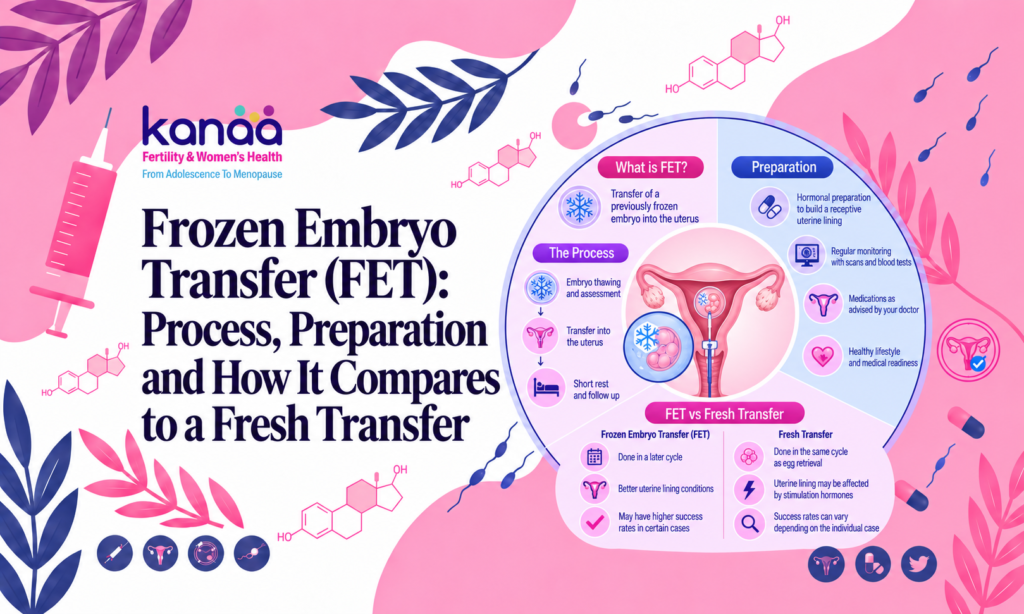
Many couples who go through IVF end up with more good-quality embryos than can be transferred at once. Others are advised to freeze all their embryos and transfer them later. In both cases, the next step is a frozen embryo transfer, often called FET.
If you have embryos in storage, or your doctor has suggested a freeze-all cycle, you may have questions about how FET works, how the uterus is prepared and whether it is as good as a fresh transfer. This guide explains each stage in simple terms. As with all fertility treatment, the right approach depends on your own medical evaluation.
Key takeaways: A frozen embryo transfer places a thawed embryo into the uterus in a later cycle. Embryos are frozen using a fast-freezing method called vitrification. The uterus is prepared either in a natural cycle or with hormone medicines. Neither fresh nor frozen transfer is best for everyone; your doctor chooses based on your situation.
What Is a Frozen Embryo Transfer?
A frozen embryo transfer (FET) is an IVF step in which an embryo that was frozen and stored is thawed and placed into the uterus. It happens in a separate cycle from the egg collection, after the uterine lining has been prepared to receive the embryo.
FET is not a separate treatment from IVF. It uses embryos created during an earlier IVF or ICSI cycle. If you would like a refresher on how embryos are created, read our guide to how IVF works.
Why Are Embryos Frozen?
Embryos are frozen for three main reasons: to store surplus embryos after a fresh transfer, to delay transfer for medical reasons in a freeze-all cycle, or to allow a pregnancy at a later time.
Surplus embryos after a fresh transfer
During IVF, several eggs may be fertilised and develop into embryos. Usually, only one embryo is transferred at a time to reduce the risks of a multiple pregnancy. Good-quality embryos that are not transferred can be frozen and used later, without going through ovarian stimulation and egg collection again.
Freeze-all cycles
Sometimes doctors advise freezing all embryos and transferring none in the stimulation cycle. Common reasons include:
- A higher risk of ovarian hyperstimulation syndrome (OHSS), a complication of stimulation medicines
- Hormone levels or a uterine lining that are not ideal for transfer in that cycle
- Waiting for the results of genetic testing of embryos. Learn more about PGT-A
- Illness, travel or other personal reasons that make a fresh transfer unsuitable
Planning a future pregnancy
Some couples freeze embryos so they can try for another child in future, using embryos created when the woman was younger. ICSI treatment cycles can also produce embryos for freezing.
How Embryos Are Frozen and Thawed
Most clinics today freeze embryos using vitrification. In this method, the embryo is treated with protective solutions and cooled extremely quickly in liquid nitrogen. The speed turns the water inside the cells into a glass-like state instead of ice crystals, which could damage the cells. Frozen embryos are stored at very low temperatures in secure tanks.
On the day of transfer, or shortly before, the embryologist thaws the embryo by warming it in a series of solutions. Most vitrified embryos survive thawing well, but not every embryo does. Your embryologist will update you before the transfer.
Freezing embryos is different from freezing eggs. Egg freezing stores unfertilised eggs, usually to preserve fertility for the future. Embryo freezing stores eggs that have already been fertilised. Read more about egg freezing.
Preparing the Uterus for FET
Before a frozen embryo transfer, the uterine lining (endometrium) must be ready to receive the embryo. Doctors prepare it in one of two main ways: a natural cycle, which follows your own ovulation, or a medicated cycle, which uses hormones.
Natural cycle FET
In a natural cycle FET, your own hormones prepare the lining. Your doctor tracks the growing follicle and ovulation with ultrasound scans and sometimes blood or urine tests. The transfer is timed a set number of days after ovulation, depending on the embryo’s stage. Some doctors add a trigger injection to time ovulation, or progesterone support after ovulation.
A natural cycle may suit women who ovulate regularly and prefer fewer medicines. It needs careful timing, and the plan may change if ovulation is irregular.
Medicated (hormone-supported) FET
In a medicated FET, often called hormone replacement therapy or HRT FET, you take oestrogen, usually as tablets or patches, to build the lining. Once the lining reaches a suitable thickness on scan, progesterone is started, often as vaginal gel, pessaries or injections. The transfer is scheduled after a set number of days of progesterone.
A medicated cycle is often used for women with irregular or absent ovulation, such as some women with PCOS. It also makes scheduling more predictable.
| Approach | Who it may suit | Medicines | Monitoring |
|---|---|---|---|
| Natural cycle FET | Women with regular ovulation | Few or none; sometimes a trigger or progesterone | Scans to track ovulation; transfer timed from ovulation |
| Modified natural cycle | Regular cycles, with more control over timing | Trigger injection, often with progesterone | Scans to time the trigger |
| Medicated (HRT) FET | Irregular or absent ovulation, or when scheduling matters | Oestrogen, then progesterone | Scans to check lining thickness |
Frozen Embryo Transfer Step by Step
A typical frozen embryo transfer cycle follows these steps:
- Planning consultation: your doctor reviews your stored embryos and chooses a protocol.
- Cycle start: the plan begins, often around the start of your period.
- Lining preparation: natural monitoring or oestrogen, with ultrasound scans.
- Progesterone or ovulation timing: once the lining is ready.
- Embryo thaw: in the lab, on or shortly before transfer day.
- Embryo transfer: a short procedure placing the embryo in the uterus.
- Luteal support: progesterone usually continues after transfer in medicated cycles.
- Pregnancy blood test: usually around two weeks after transfer.
The whole cycle usually takes about three to five weeks from start to pregnancy test, depending on the protocol.
Fresh vs Frozen Embryo Transfer
A fresh embryo transfer happens a few days after egg collection, in the same cycle. A frozen embryo transfer happens in a later cycle after the embryo has been frozen and thawed. Both can lead to healthy pregnancies, and the right choice depends on your individual situation.
| Factor | Fresh embryo transfer | Frozen embryo transfer |
|---|---|---|
| Timing | 3 to 5 days after egg collection, same cycle | In a later cycle, after thawing |
| Uterine environment | Affected by stimulation medicines and hormone levels | Prepared in a natural or medicated cycle without recent stimulation |
| OHSS risk | Pregnancy can worsen OHSS in high-risk women | Allows the ovaries to settle before pregnancy |
| Genetic testing | Usually not possible to wait for results | Allows time for embryo testing results |
| Scheduling | Fixed by the stimulation cycle | More flexible |
| Extra steps | None | Freezing, storage and thawing, with small risk of embryo loss |
| Cost | No freezing or storage costs | Freezing, storage and FET cycle costs |
What research compares
Researchers have compared fresh and frozen transfers in many studies. The findings differ between patient groups. For some groups, such as women at high risk of OHSS, a freeze-all approach may offer advantages. For many others, results are broadly similar, and there is no single approach that suits every patient.
How doctors decide for an individual patient
Your doctor will consider your response to stimulation, OHSS risk, hormone levels, the lining on scan, whether embryo testing is planned, and your personal circumstances. Ask your doctor to explain why they recommend one approach for you. For questions to ask about a clinic’s lab and freezing process, see our guide on how to choose an IVF clinic.
What the Transfer Day Feels Like
A frozen embryo transfer is a short and usually painless procedure. Many women say it feels similar to a smear test.
On the day, you may be asked to come with a comfortably full bladder, as this helps the doctor see the uterus clearly on ultrasound. You lie on the couch, a speculum is placed, and a very thin, soft catheter carrying the embryo is passed gently through the cervix into the uterus under ultrasound guidance. The embryo is released, the catheter is removed and checked, and the procedure is complete. It usually takes only a few minutes and does not need anaesthesia.
Most women rest briefly and then go home. Your partner can usually be with you.
After the Transfer: The Two-Week Wait
The days between embryo transfer and the pregnancy test can feel long. Most women can return to light daily activities soon after the transfer. Strict bed rest is generally not needed. Continue any progesterone or other medicines exactly as prescribed, and do not stop them without speaking to your clinic.
Try not to take a home pregnancy test too early. It may show a false negative, or a false positive if you have had a trigger injection. Your clinic will arrange a blood test at the right time. Contact your clinic if you have heavy bleeding, severe pain, fever or any symptom that worries you.
For more detailed advice on what to do and avoid, read our guide to dos and don’ts after the procedure.
How Long Can Embryos Stay Frozen?
Vitrified embryos can remain viable in storage for many years, as long as they are stored correctly. In India, the storage of embryos is governed by the Assisted Reproductive Technology (Regulation) Act, 2021, which sets rules on storage periods, consent and what happens to embryos that are no longer needed.
Before freezing, you will sign consent forms covering storage, renewal and what you want to happen to embryos in future. Keep your contact details up to date with the clinic, and review your decisions if your circumstances change.
Costs to Plan For
When planning a frozen embryo transfer, it helps to think of the costs in separate parts:
- Embryo freezing, usually charged when embryos are first frozen
- Yearly storage fees
- The FET cycle: consultations, scans, blood tests and medicines
- Thawing and the transfer procedure
- Any additional tests your doctor recommends
Ask your clinic for a written estimate for each part.
Who May Benefit From a Frozen Embryo Transfer?
A frozen embryo transfer may be a particularly good option in certain situations. Your doctor may suggest FET if:
- You had a strong response to stimulation and are at risk of OHSS
- Your uterine lining or hormone levels were not ideal at the time of egg collection
- Your embryos are being genetically tested and you need to wait for the results
- You have stored embryos from a previous cycle and want to try again without another egg collection
- You want to plan a sibling pregnancy using embryos created earlier
- You became unwell, or had to travel, around the time of a planned fresh transfer
FET may be less suitable, or need extra planning, if you have very few embryos, or if a medical condition needs to be treated before transfer. Your doctor will discuss this with you.
Questions to Ask Before Your Frozen Embryo Transfer
Bring these questions to your planning consultation:
- How many embryos do we have in storage, and at what stage were they frozen?
- Which embryo will be transferred first, and why?
- Do you recommend a natural or medicated cycle for me, and why?
- How many scans and visits will I need, and on which days?
- Which medicines will I take, for how long, and what side effects should I expect?
- What happens if my lining is not thick enough, or if I ovulate early?
- What are the chances that the embryo survives thawing, based on your lab’s experience?
- When will my pregnancy blood test be, and whom do I call with questions?
Writing down the answers can help, as there is a lot of information to remember during treatment.
Conclusion
A frozen embryo transfer gives many couples another chance at pregnancy without repeating stimulation and egg collection. It also allows doctors to choose the best time to transfer an embryo, which can be important for some patients. Whether a fresh or frozen transfer is right for you depends on your own medical picture.
If you have embryos stored, or you are planning IVF, Kanaa Fertility’s team in KK Nagar and Mylapore, Chennai, can explain whether a frozen transfer suits you and what the process would involve. Book a consultation to discuss your options.
Frequently Asked Questions
Is a frozen embryo transfer painful?
Most women describe it as similar to a smear test. It usually does not need anaesthesia and takes only a few minutes.
Is frozen better than fresh embryo transfer?
Neither is best for everyone. Doctors choose based on your hormone levels, uterine lining, risk of OHSS and whether embryos are being genetically tested.
How long can embryos stay frozen?
Vitrified embryos can be stored for many years. In India, storage periods and consent are governed by the ART (Regulation) Act, so your clinic will explain the rules that apply.
When should I take a pregnancy test after a frozen embryo transfer?
Clinics usually schedule a blood test around two weeks after the transfer. Testing too early at home can give a misleading result.
Do all embryos survive thawing?
Most vitrified embryos survive thawing, but not every embryo does. Your embryologist will update you on the day of transfer.
Do I need hormone medicines for a frozen embryo transfer?
Not always. A natural cycle FET may use few or no medicines, while a medicated FET uses oestrogen and progesterone to prepare the lining.
Can I go to work after a frozen embryo transfer?
Many women return to light daily activities and desk work soon after transfer. Ask your doctor about anything specific to your job or health.