
Important: This article gives general information about Indian surrogacy law as understood at the time of writing. It is not legal advice. Rules and court decisions can change, so please confirm your situation with your clinic and a qualified lawyer.
For some couples and women, surrogacy is the only route to having a child who is genetically their own. In India, surrogacy is allowed, but it is tightly controlled by law. Understanding the rules before you begin saves time, prevents disappointment and helps you plan with confidence.
This guide explains, in plain language, who can opt for surrogacy in India, who can act as a surrogate, what the law allows and prohibits, and the approvals needed. It focuses on the law. For the medical side, read our guide to surrogacy types, process and success rates.
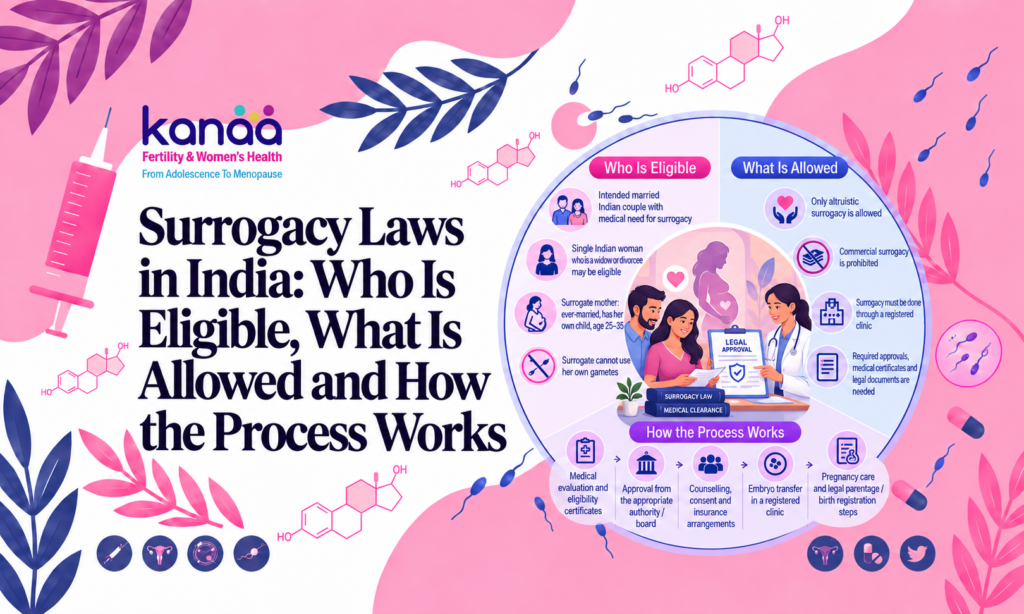
Key takeaways: Surrogacy is legal in India only in its altruistic form. Commercial surrogacy is banned. Eligible intending couples and certain single women must meet age and medical criteria and obtain official certificates. Surrogates must also meet strict conditions. Legal and medical guidance should be taken before starting.
Is Surrogacy Legal in India?
Yes, surrogacy is legal in India, but only altruistic surrogacy is allowed. This means the surrogate mother cannot be paid a fee beyond medical expenses and insurance. Commercial surrogacy, where a woman is paid to carry a pregnancy, is banned under the Surrogacy (Regulation) Act, 2021.
The law aims to protect surrogate mothers from exploitation and to protect the rights of children born through surrogacy. It also sets out who may use surrogacy and when.
The Laws That Govern Surrogacy
Two main laws apply:
- The Surrogacy (Regulation) Act, 2021 sets out who can opt for surrogacy, who can be a surrogate, what is allowed and what is an offence.
- The Assisted Reproductive Technology (Regulation) Act, 2021 regulates IVF clinics and banks, which carry out the medical procedures used in surrogacy.
Both laws are supported by rules issued by the government, which have been amended since 2021. Courts have also considered several cases on how the rules apply.
Who Can Opt for Surrogacy?
Under Indian law, surrogacy is available to eligible married Indian couples with a medical need, and to certain single women. Each must meet age, medical and other conditions, and obtain official certificates before starting.
Married couples
An intending couple generally needs to meet these conditions:
- They are a legally married Indian couple
- The wife is aged between 23 and 50 years, and the husband between 26 and 55 years
- There is a medical indication that makes gestational surrogacy necessary, certified by a medical board
- They do not have a surviving child, with exceptions, for example where a child has a serious disability or life-threatening illness
Single women
The law allows some single women to opt for surrogacy, such as widowed or divorced women within a specified age range (reported as 35 to 45 years).
NRIs, OCI holders and foreign nationals
Surrogacy for foreign nationals is restricted under Indian law. The position of Non-Resident Indians and Overseas Citizens of India depends on the current rules and, in some cases, court decisions. Anyone in this group should take specific legal advice before planning.
| Person | Generally eligible? | Key conditions |
|---|---|---|
| Married Indian couple | Yes | Age limits, medical indication, certificates |
| Widowed or divorced woman | Yes, within limits | Age range and medical criteria |
| Unmarried single woman | Check current law | Check current law |
| Single man | Check current law | Check current law |
| NRI or OCI holder | Depends on current rules | Legal advice needed |
| Foreign national | Restricted | Legal advice needed |
Who Can Be a Surrogate?
A surrogate mother in India must meet strict conditions set by law. These are generally understood to include:
- She is a married woman with a child of her own
- She is aged between 25 and 35 years on the day of implantation
- She can act as a surrogate only once in her lifetime
- She has a certificate of medical and psychological fitness
- She gives informed consent in writing, and can withdraw consent before the embryo is implanted
The original Act also referred to the surrogate being a close relative of the intending couple. How this is applied has been debated, so check the current position.
A surrogate cannot be forced or pressured to take part, and her own health and wellbeing must be protected throughout.
What Is Allowed and What Is Not
Altruistic vs commercial surrogacy
Altruistic surrogacy means the surrogate receives no payment or reward beyond medical expenses and insurance cover. This is the only form allowed in India.
Commercial surrogacy means paying the surrogate a fee, or offering any other monetary benefit or reward. This is prohibited, and advertising or arranging commercial surrogacy is an offence.
What expenses may be covered for the surrogate
The intending couple or woman is expected to pay the surrogate’s medical expenses and to buy insurance cover for her for a specified period, reported as 36 months, covering complications arising from pregnancy and childbirth.
Use of donor eggs or sperm
The rules on donor gametes have changed since 2021. A 2023 amendment restricted the use of donor gametes, and a 2024 amendment allowed a donor egg or donor sperm to be used in certain medically certified situations, with at least one gamete coming from the intending couple. Single women were reported to need to use their own eggs.
| Allowed | Not allowed |
|---|---|
| Altruistic surrogacy for eligible couples and women | Commercial surrogacy or paying a surrogate a fee |
| Covering the surrogate’s medical costs and insurance | Advertising for or arranging paid surrogacy |
| Donor gametes in specified medical situations | Abandoning or disowning the child |
| Surrogacy through a registered clinic | Sex selection |
| Withdrawal of consent by the surrogate before implantation | Selling or trading embryos or gametes |
Certificates and Approvals Needed
Before surrogacy can begin, the intending couple or woman usually needs two main certificates from the appropriate authority, supported by a medical board and a court order:
- Certificate of essentiality: confirms the medical need for surrogacy, issued on the basis of a District Medical Board certificate. It also involves a court order on the parentage and custody of the child, and proof of insurance for the surrogate.
- Eligibility certificate: confirms that the intending couple or woman meets the legal eligibility conditions, such as age and marital status.
The surrogate also needs her own eligibility and fitness certification.
The usual order of steps is:
- Medical evaluation at a registered fertility clinic
- Certificate from the District Medical Board confirming the medical need
- Court order on the parentage and custody of the child
- Insurance cover arranged for the surrogate
- Certificates issued by the appropriate authority
- IVF and embryo transfer to the surrogate
How the Medical Process Fits In
Surrogacy in India is gestational. This means the surrogate carries an embryo created through IVF and is not genetically related to the baby. The eggs are collected from the intending mother (or, where allowed, a donor), fertilised in the lab with sperm, and the resulting embryo is transferred to the surrogate’s uterus.
The medical steps follow the same process as IVF, with careful coordination between the intending parents and the surrogate. For a full explanation, read surrogacy types, process and success rates or learn about IVF treatment in Chennai.
Legal Rights of the Child and the Surrogate
A child born through surrogacy under the Act is treated as the biological child of the intending couple or woman, with all the rights of a natural child. The intending parents cannot abandon the child for any reason, including a health condition or the child’s sex.
The surrogate is protected too. She has the right to informed consent, medical care, insurance cover and freedom from coercion. She can withdraw consent before the embryo is implanted.
Common Myths About Surrogacy in India
Myth: Surrogacy is banned in India. Surrogacy is legal. Only commercial surrogacy is banned.
Myth: Anyone can choose surrogacy for convenience. The law requires a medical need that is certified by a medical board.
Myth: The surrogate is the child’s legal mother. Under the Act, the intending parents are the legal parents.
Myth: The clinic handles every legal step. Clinics guide the medical side and the medical certificates, but steps such as court orders usually need a lawyer.
How a Fertility Clinic Supports You
A fertility clinic plays a key role in the surrogacy journey. It assesses whether surrogacy is medically necessary, carries out IVF and embryo transfer, screens the surrogate medically, and helps you understand the documents required. Counselling for both the intending parents and the surrogate is an important part of this support.
At Kanaa Fertility, our team can carry out the medical evaluation and explain the next steps. Learn more about surrogacy at Kanaa Fertility. If you are still comparing clinics, our guide on how to choose an IVF clinic may help.
Questions to Ask Before Starting Surrogacy
Before starting the surrogacy process, it helps to ask your clinic and legal adviser:
- Does my medical condition meet the legal requirement for surrogacy?
- Do we meet the current age, marital status and other eligibility conditions?
- Which certificates do we need, from which authority, and how long does the process usually take?
- Who will the surrogate be, and does she meet the legal conditions?
- What insurance must be arranged for the surrogate, and for how long?
- Can we use our own eggs and sperm, or is a donor gamete needed and allowed in our situation?
- What counselling is available for us and for the surrogate?
- What are the likely medical costs, and which costs are we legally required to cover?
Keep copies of every document, certificate and consent form in one place. The process involves several authorities, and good records prevent delays.
Other Options to Discuss With Your Doctor
Surrogacy is usually considered when a woman cannot safely carry a pregnancy, for example because of the absence of a uterus, severe damage to the uterine lining, or a medical condition that makes pregnancy dangerous. Before deciding, it is worth asking whether any condition affecting the uterus can be treated. Some problems, such as certain scar tissue inside the uterus, may be treated with hysteroscopy.
Adoption is another path to parenthood for some families. In India, adoption is regulated through the Central Adoption Resource Authority (CARA). Many couples find it helpful to explore every option with a counsellor before choosing the path that feels right for them.
Conclusion
Surrogacy in India is legal but carefully regulated. Only altruistic surrogacy is allowed, and intending parents and surrogates must meet clear conditions and obtain official certificates. Because the rules have changed several times since 2021, it is essential to check the current position before you begin.
Surrogacy decisions are personal and legally detailed. Speak with Kanaa Fertility’s team in KK Nagar or Mylapore, Chennai, for a medical evaluation and guidance on the next steps, alongside independent legal advice. Book a consultation.
Frequently Asked Questions
Is commercial surrogacy allowed in India?
No. Indian law allows only altruistic surrogacy. The surrogate cannot be paid a fee, though her medical expenses and insurance are covered by the intending parents.
Can single women opt for surrogacy in India?
The law allows some single women, such as widowed or divorced women within a set age range. Confirm the current conditions with your clinic and a legal adviser before planning.
Can foreign nationals opt for surrogacy in India?
Surrogacy for foreign nationals is restricted under Indian law. Rules for NRIs and OCI holders are specific, so take legal advice for your situation.
Can donor eggs or sperm be used in surrogacy in India?
The rules on donor gametes have changed since 2021. Current rules allow donor gametes only in specific medically certified situations, so check the latest position before planning.
How many times can a woman be a surrogate in India?
Under the Act, a woman can act as a surrogate only once in her lifetime. Your clinic can confirm the current rules.
Who is the legal parent of a child born through surrogacy?
The law treats the intending couple or intending woman as the child’s legal parents, with a court order confirming parentage and custody.
Does the fertility clinic handle the legal paperwork?
Clinics guide patients on the medical assessment and medical certificates. Legal steps such as court orders usually need a lawyer.