
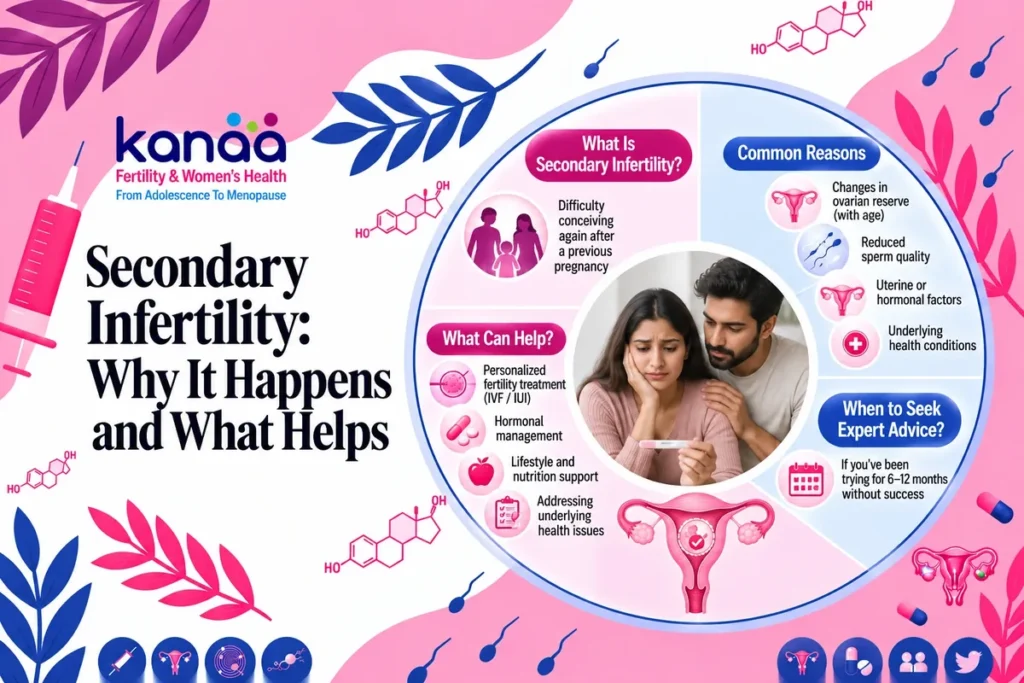
Secondary infertility means difficulty getting pregnant again after a previous pregnancy, even when the first pregnancy happened easily. Common causes include the woman’s age, changes in ovulation, tubal or uterine problems after a previous birth or surgery, conditions such as thyroid disease, and new changes in the male partner’s sperm. Doctors usually suggest tests after 12 months of trying, or 6 months if the woman is 35 or older.
Many parents are surprised when a second pregnancy does not come as easily as the first. Friends and family may assume that conceiving again should be simple, which can leave couples feeling confused, guilty or unheard. Secondary infertility is a real and common medical condition, and the same careful approach used for a first pregnancy applies here. This guide explains why it happens, when to seek help, which tests are useful and what treatment options exist.

What is secondary infertility?
Doctors describe infertility as not conceiving after 12 months of regular unprotected intercourse. When a couple has been pregnant before, whether or not that pregnancy led to a birth, and then has difficulty conceiving again, it is called secondary infertility. Primary infertility is the term used when a couple has never conceived.
Secondary infertility can affect a couple trying for a second child, a couple trying again after a miscarriage, or a person trying to conceive with a new partner. The causes and the tests are largely the same as for primary infertility, but some causes, such as changes after childbirth or surgery, are more specific to it.
How common is secondary infertility?
Infertility affects a significant number of couples worldwide. The World Health Organization estimates that around one in six people experience infertility at some point in their lives, and studies suggest that a large share of these have conceived before. In other words, if you are finding it hard to conceive again, you are far from alone.
Possible causes in women
Age and egg reserve
A woman’s age is the single biggest factor in fertility. Several years may have passed since the first pregnancy, and both the number and quality of eggs fall gradually with age, more noticeably after 35. An AMH blood test and an ultrasound count of small follicles give an estimate of egg reserve. Read what is the ovarian reserve.
Changes in ovulation
Ovulation can change after a first pregnancy. Common reasons include:
- Weight gain or loss since the first pregnancy
- Polycystic ovary syndrome (PCOS) that becomes more noticeable over time
- Thyroid problems, which can develop after childbirth. See thyroid and fertility
- High prolactin levels. See high prolactin and fertility
- Breastfeeding, which can delay the return of regular ovulation
- Stress and disturbed sleep, common with a young child at home
Irregular or absent periods are a clear sign to see a doctor. Read about anovulation.
Tubal problems after childbirth, miscarriage or surgery
Infection after a delivery, miscarriage or pelvic surgery can sometimes damage the fallopian tubes or cause adhesions. A tube test such as an HSG or SSG checks whether the tubes are open.
Changes in the uterus
- Scar tissue inside the uterus after a D&C or uterine infection can affect implantation.
- A caesarean scar defect, a small pouch in the scar on the uterus, may affect fertility in some women.
- Fibroids or polyps may have developed since the first pregnancy.
An ultrasound and, if needed, a hysteroscopy can find and often treat these problems.
Endometriosis
Endometriosis can progress over time and cause painful periods, pain during intercourse and fertility problems. It may be diagnosed and treated with laparoscopy.
Other health conditions
Diabetes, autoimmune conditions and some medicines started since the first pregnancy can affect fertility. Your doctor will review your full health history.
Possible causes in men
The male partner’s fertility can change too, even if he fathered the first child. Possible reasons include:
- Age, as sperm quality declines gradually after about 40
- Weight gain, smoking, alcohol or stress
- New health conditions such as diabetes
- Medicines, including testosterone or muscle-building products
- A varicocele, enlarged veins in the scrotum
- Infection or injury
This is why the male partner should always have a semen analysis, even when a previous pregnancy happened easily. Read signs of infertility in men.
Causes that involve both partners
Sometimes no single cause is found. Timing of intercourse may also have changed with a young child at home, busy schedules or travel. Learning to identify the fertile window can help. See how to tell when you are ovulating and trying for pregnancy: what is the right time.
Trying again after a miscarriage
Secondary infertility also includes couples who conceived before but lost the pregnancy. After a single miscarriage, most women can try again once they feel ready physically and emotionally, and many go on to conceive without treatment. Your doctor may suggest waiting for one normal period so that dates are easier to track.
If conception does not happen in the expected time, or if there have been two or more losses, tests are advised. These may include hormone tests, a scan of the uterus, blood tests for clotting and immune factors, and chromosome tests for both partners. Read recurrent miscarriage: causes and tests.
Common myths about secondary infertility
- “If we had a baby before, we must still be fertile.” Fertility can change over time for both partners. A past pregnancy does not guarantee the next.
- “It is always the woman’s age.” Age matters, but tubal, uterine and male factors are also common causes.
- “Stress is the main reason.” Stress can affect wellbeing and intimacy, but a medical cause should always be ruled out.
- “We should wait longer because it worked before.” If you are over 35, or have any risk factors, waiting can reduce options. Early tests are simple.
When should you see a fertility specialist?
See a fertility specialist if:
- The woman is under 35 and you have been trying for 12 months
- The woman is 35 or older and you have been trying for 6 months
- Periods are irregular, very painful or absent
- There was an infection, heavy bleeding or a complicated delivery after the last birth
- There has been a D&C, caesarean section or other pelvic surgery and you have concerns
- You have had two or more miscarriages. See recurrent miscarriage: causes and tests
- There is a known issue with the male partner’s health or sperm
It is fine to seek advice earlier. Simply checking basic tests can be reassuring.
Tests for secondary infertility
Tests are similar to those for primary infertility and cover both partners.
| Test | Partner | What it checks |
|---|---|---|
| AMH and early cycle hormones | Woman | Egg reserve and ovarian function |
| Thyroid and prolactin | Woman | Hormones that affect ovulation |
| Pelvic ultrasound | Woman | Uterus, ovaries, fibroids, polyps, scar changes |
| HSG or SSG | Woman | Whether the fallopian tubes are open |
| Hysteroscopy (if needed) | Woman | Inside of the uterus |
| Semen analysis | Man | Sperm count, movement and shape |
| Hormone tests (if needed) | Man | Testosterone, FSH, LH |
Our fertility test for couples brings these together in one plan.
What to expect at your first appointment
At the first visit, the doctor talks with both partners about your previous pregnancy and birth, any complications, how long you have been trying, your cycles and your general health. Bring any reports from your first pregnancy, especially delivery notes, scan reports and details of any surgery.
Most couples leave with a short list of tests timed to the woman’s cycle, and a semen analysis appointment for the man. Results are usually reviewed together at a follow-up visit, where the doctor explains what they mean and suggests next steps. Read what to expect after your first fertility consultation.
Treatment options
Treatment depends on what the tests show. Options include:
- Treating a specific cause, such as correcting thyroid levels, lowering prolactin or managing PCOS
- Ovulation induction for irregular ovulation. See ovulation induction
- Surgery to remove polyps, fibroids or scar tissue, or to treat endometriosis
- IUI for mild male factor, ovulation problems or unexplained infertility
- IVF or ICSI for tubal damage, lower egg reserve, significant male factor or when simpler treatments have not worked
For a full overview, read types of fertility treatment.
Coping with secondary infertility
Secondary infertility brings its own emotional challenges. Couples often feel they should simply be grateful for the child they have, and may hide their distress. Others feel uncomfortable at school gatherings or family events surrounded by pregnancies and second babies. Some feel guilty about the time and energy spent on treatment instead of with their child.
These feelings are normal. Things that help:
- Talking openly with your partner about how each of you feels
- Setting limits on how much you share with family
- Planning treatment around your child’s routine where possible
- Seeking support from a counsellor. See fertility counselling and emotional support
Practical tips while trying again
- Keep a simple record of your cycle dates.
- Aim for intercourse every two to three days, especially around the fertile window.
- Keep a healthy weight, eat balanced meals and stay active.
- Stop smoking and limit alcohol, for both partners.
- Take folic acid as advised by your doctor when planning pregnancy.
- Review any regular medicines with your doctor before trying.
If you are planning ahead, a preconception counselling visit can help prepare both of you.
Planning the gap between children
Some couples choose to wait a few years before trying for a second child, for health, work or family reasons. If you are planning a gap, keep in mind that the woman’s egg reserve continues to fall with age, and more gradually so does sperm quality. If the woman will be over 35 when you plan to try again, or there were any difficulties conceiving the first time, a check-up before you start trying can help you plan. Simple tests such as AMH and a semen analysis give a useful picture, and your doctor can advise whether waiting longer is likely to affect your options.
Frequently asked questions
Why can’t I get pregnant again after my first child?
Common reasons include age-related changes in egg reserve, ovulation problems, tubal or uterine changes after a previous birth or surgery, and changes in the male partner’s sperm. Tests for both partners usually identify the cause.
Does a previous caesarean section affect fertility?
Most women conceive normally after a caesarean. In some, a defect in the scar or adhesions may affect fertility. An ultrasound or hysteroscopy can check for this.
Is secondary infertility treatable?
Yes, in many cases. Treatment depends on the cause and may include treating hormone problems, ovulation induction, surgery, IUI or IVF.
Can breastfeeding stop me from getting pregnant?
Breastfeeding, especially frequent feeding, can delay the return of regular ovulation. Once periods return regularly, fertility usually returns too. If you are concerned, speak to your doctor.
Does my partner need tests if he already has a child?
Yes. Sperm quality can change over time with age, health and lifestyle, so a semen analysis is always advised.
How long should we try before seeing a doctor?
After 12 months if the woman is under 35, after 6 months if she is 35 or older, and sooner if there are irregular periods or known health concerns.
Book a couple fertility check
Kanaa Fertility Centre helps couples with secondary infertility at our centres in KK Nagar and Mylapore, Chennai, with tests for both partners, fertility surgery, IUI and IVF. Book a fertility test for couples or contact us to speak with our team.
This article is for general information. Every couple is different, and your doctor will recommend tests and treatment based on your individual evaluation.