
Losing a pregnancy is painful, and going through it more than once can leave you feeling heartbroken, confused and afraid to try again. Please know that what happened was not caused by something you did, and that support and answers are available. If you are finding it hard to conceive again, read about secondary infertility.
This guide explains what recurrent miscarriage means, the possible causes, the tests doctors may suggest, and the next steps you can discuss with a specialist. Every situation is different, so your own plan depends on a careful medical evaluation.

What is recurrent miscarriage?
Recurrent miscarriage, also called recurrent pregnancy loss, means losing two or more pregnancies, usually before 20 weeks. Some guidelines use two losses and others use three before suggesting tests. Many couples with recurrent miscarriage go on to have a successful pregnancy, and an evaluation can help find causes that may be treated.
Your doctor will explain which definition and testing approach suits you, based on your age and history.
How common is miscarriage?
Miscarriage in early pregnancy is common, and a single miscarriage is usually caused by chance chromosome changes in the pregnancy. Repeated losses are much less common, which is why doctors look for underlying causes after more than one loss.
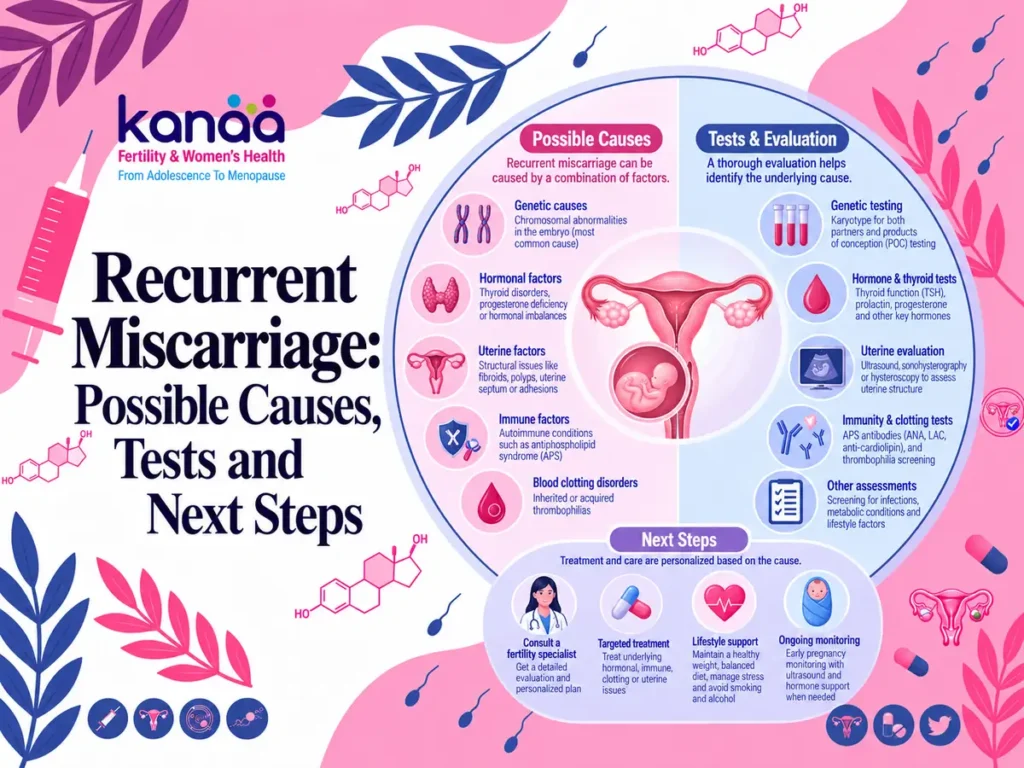
Possible causes of recurrent miscarriage
In many couples, a clear cause is not found, even after full testing. This can be frustrating, but it can also be reassuring, because many of these couples still have a successful pregnancy later.
| Area | Possible causes | How it may be checked |
|---|---|---|
| Chromosomes | Changes in the pregnancy, or a balanced chromosome change in one partner | Testing of pregnancy tissue, parental blood karyotype |
| Uterus | Uterine septum, fibroids in the cavity, polyps, scarring | 3D ultrasound, saline sonography, hysteroscopy |
| Hormones | Thyroid problems, poorly controlled diabetes, prolactin issues | Blood tests |
| Blood clotting and immune | Antiphospholipid syndrome | Specific blood tests, repeated if positive |
| Age | Egg quality changes with age | History and ovarian reserve tests |
| Lifestyle | Smoking, heavy alcohol use, high body weight | Health review |
| Sperm | Sperm DNA damage in some couples | Semen analysis, selected sperm tests |
Chromosome factors
Most single miscarriages happen because the pregnancy has the wrong number of chromosomes. Rarely, one partner carries a balanced chromosome change that does not affect their own health but can affect a pregnancy. A simple blood test for both partners can check for this when advised.
Uterine factors
The shape of the uterus can matter. A uterine septum (a wall of tissue dividing the cavity) or a fibroid inside the cavity may be linked with pregnancy loss in some women. Many of these can be treated through hysteroscopy.
Hormonal factors
Thyroid problems and poorly controlled diabetes can affect early pregnancy. Checking and managing these before the next pregnancy is an important step.
Antiphospholipid syndrome
This is an immune condition that increases the tendency of blood to clot. It is one of the treatable causes of recurrent miscarriage, and it is diagnosed with specific blood tests.
Tests that may be advised for both partners
Not everyone needs every test. Your doctor will choose tests based on your history.
- Detailed history of each pregnancy loss
- Pelvic ultrasound, often 3D, or saline sonography to check the uterine cavity
- Hysteroscopy if a cavity problem is suspected
- An endometrial biopsy in selected cases
- Thyroid, blood sugar and other hormone tests
- Antiphospholipid antibody tests
- Chromosome tests for both partners, in selected cases
- Testing of pregnancy tissue from a future loss, if possible
- Semen analysis for the male partner
Treatment and support options
Treatment depends on what the tests show:
- Uterine problems such as a septum or cavity fibroid may be treated with hysteroscopic surgery.
- Hormonal conditions such as thyroid problems or diabetes are managed before the next pregnancy.
- Antiphospholipid syndrome is usually managed with medicines during pregnancy prescribed by a specialist.
- Chromosome changes in a partner may lead to genetic counselling and a discussion of IVF with PGT in some cases.
- Lifestyle support such as stopping smoking and reaching a healthy weight.
- Early pregnancy care with close monitoring and reassurance scans in the next pregnancy.
Please do not start any medicine for miscarriage prevention on your own. Treatments that help one cause may not help another.
Can you have a successful pregnancy after recurrent miscarriage?
Yes. Many couples who have had recurrent miscarriages go on to have a successful pregnancy, including couples for whom no cause is found. Your chances depend on your age, the number of previous losses and any cause identified. Supportive early pregnancy care can also help couples feel more secure.
Recurrent miscarriage vs failed implantation
Recurrent miscarriage means a pregnancy test was positive and the pregnancy ended. Failed implantation after IVF means the embryo did not attach and the pregnancy test stayed negative. These are investigated differently.
Emotional support
Grief after pregnancy loss is real, for both partners. Give yourselves time, and consider talking with a counsellor before planning the next pregnancy. Emotional readiness matters as much as medical readiness.
When to see a specialist
- After two or more pregnancy losses
- After one loss if you are over 35, or if you have a known medical condition
- If you have a known thyroid, clotting or uterine problem and want to plan pregnancy
Key points
- Recurrent miscarriage usually means two or more pregnancy losses.
- A cause is not always found, and many couples still go on to have a successful pregnancy.
- Tests may look at chromosomes, the uterus, hormones and blood clotting.
- Several causes, such as uterine septum and antiphospholipid syndrome, can be treated.
- Both partners may be tested.
Book a confidential consultation
If you have experienced more than one pregnancy loss, our specialists at Kanaa Fertility in KK Nagar and Mylapore, Chennai, can talk you through tests and next steps with care and privacy. Book a consultation when you feel ready.
Frequently Asked Questions
How many miscarriages are considered recurrent?
Recurrent miscarriage usually means two or more pregnancy losses. Some guidelines use three. Your doctor will advise when testing is right for you.
What tests are done after recurrent miscarriage?
Tests may include a uterine scan or hysteroscopy, thyroid and hormone tests, antiphospholipid antibody tests, chromosome tests for both partners and a semen analysis, depending on your history.
Can recurrent miscarriage be treated?
Some causes can be treated, such as a uterine septum, thyroid problems or antiphospholipid syndrome. Even when no cause is found, many couples go on to have a successful pregnancy.
Is recurrent miscarriage caused by something I did?
No. Most pregnancy losses are caused by factors outside your control, such as chromosome changes in the pregnancy.
Should my husband also be tested?
Yes, in many cases. Chromosome tests and a semen analysis for the male partner may be part of the evaluation.
How long should we wait before trying again after a miscarriage?
The right time depends on your physical recovery, test results and emotional readiness. Your doctor will guide you.