
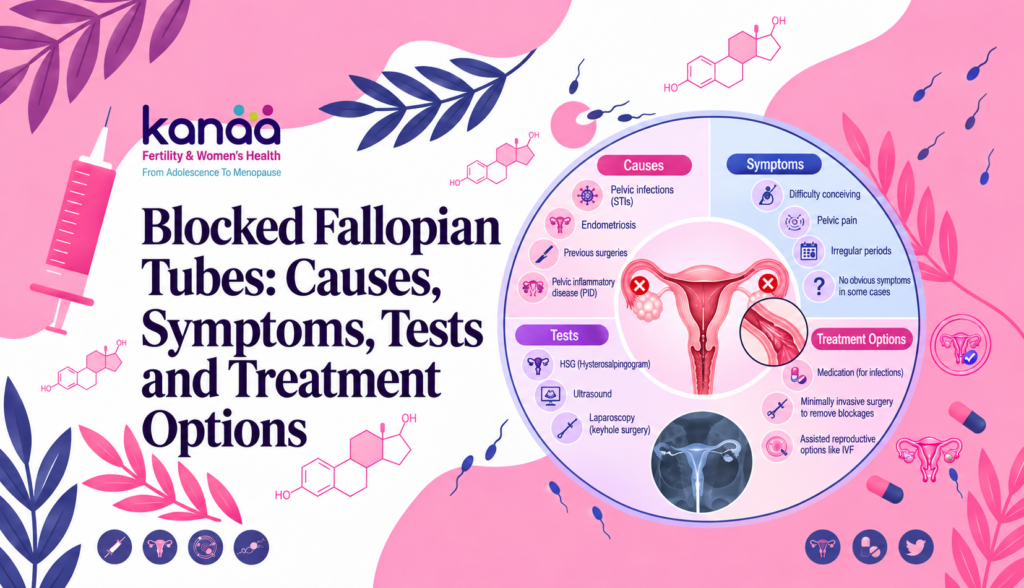
Finding out that your fallopian tubes may be blocked can feel worrying, especially if you have been trying to conceive for a while. Many women only learn about it during routine fertility tests, because a blockage rarely causes obvious symptoms. The encouraging news is that blocked fallopian tubes can be diagnosed clearly, and there are several ways to help you move forward.
This guide explains what the fallopian tubes do, what can block them, how doctors confirm a blockage, and the treatment options available today. Every woman’s situation is different, so the right option always depends on a full medical evaluation of both partners.
Key takeaways: Blocked fallopian tubes are a common cause of infertility, often with no symptoms. They are usually found through an HSG test, an SSG test or laparoscopy. Depending on where the blockage is, treatment may include a minor procedure, keyhole surgery or IVF, which does not need the tubes to be open.
What Are Blocked Fallopian Tubes?
Blocked fallopian tubes are tubes that are narrowed, scarred or closed, so the egg and sperm cannot meet or the fertilised egg cannot travel to the uterus. A blockage can affect one tube or both, and it may sit near the uterus, near the ovary or along the tube itself.
What the fallopian tubes do during conception
You have two fallopian tubes, one on each side of the uterus. Each month, when an egg is released from the ovary, the finger-like end of the tube gently picks it up. Sperm travel up through the cervix and uterus into the tube, and fertilisation usually happens inside it. The tube then carries the early embryo towards the uterus over a few days, where it can implant.
Because so much happens inside the tubes, even a partial blockage or damage to the delicate inner lining can make natural conception harder.
Types of tubal blockage
Doctors usually describe a blockage by where it is and what it looks like:
- Proximal blockage: near the point where the tube joins the uterus. This is sometimes caused by a small plug of mucus or debris, or by scarring.
- Mid-tubal blockage: along the length of the tube, sometimes after a previous tubal surgery or sterilisation.
- Distal blockage: at the end near the ovary. This is often linked to past infection or adhesions.
- Hydrosalpinx: a distal blockage where the tube swells and fills with fluid. It matters especially for IVF, as explained below.
- One tube or both: a single blocked tube affects fertility differently from two blocked tubes.
What Causes Blocked Fallopian Tubes?
The most common cause of blocked fallopian tubes is scarring from past pelvic infection. Other causes include endometriosis, previous surgery, an earlier ectopic pregnancy and adhesions. In many women, the exact cause is never fully known.
Pelvic infections and pelvic inflammatory disease
Pelvic inflammatory disease (PID) is an infection of the uterus, tubes or ovaries. It is often linked to sexually transmitted infections such as chlamydia or gonorrhoea, but other bacteria can also be involved. PID can heal with scarring inside or around the tubes. Some infections cause few symptoms, so a woman may not know she ever had one.
Genital tuberculosis is another important cause in India. It can affect the tubes and the lining of the uterus, sometimes without typical chest symptoms. If your doctor suspects it, specific tests may be advised.
Endometriosis
Endometriosis happens when tissue similar to the lining of the uterus grows outside it. It can create inflammation and adhesions that distort or block the tubes. You can read more in our guide to endometriosis and fertility.
Previous surgery or ectopic pregnancy
Surgery on the abdomen or pelvis, such as for a burst appendix, ovarian cysts or a caesarean section, can sometimes leave adhesions. A previous ectopic pregnancy, where the pregnancy grew inside the tube, can damage that tube or require its removal. Tubal sterilisation also closes the tubes on purpose.
Adhesions and scar tissue
Adhesions are bands of scar tissue that can stick organs together. Around the tubes, they can pull the tube out of shape or stop its end from picking up the egg, even when the inside of the tube is open.
Do Blocked Fallopian Tubes Cause Symptoms?
Most women with blocked fallopian tubes have no symptoms at all. Periods are usually normal, which is why a blockage is often found only during fertility testing.
Some women may notice symptoms linked to the underlying cause rather than the blockage itself. Examples include:
- Pelvic pain or pain during intercourse, which may point to endometriosis or adhesions
- Unusual vaginal discharge, fever or pelvic pain, which may suggest an active infection and needs prompt medical care
- A dull ache on one side of the lower abdomen, which some women with a hydrosalpinx report
The main sign for most couples is simply that pregnancy has not happened after trying for some time. If you have been trying for 12 months (or 6 months if you are over 35), it is worth reading when to see a fertility specialist.
How Are Blocked Fallopian Tubes Diagnosed?
Blocked fallopian tubes are usually diagnosed with an HSG test, an SSG test or a laparoscopy with dye. Your doctor chooses the test based on your history, symptoms and what other information is needed.
HSG (hysterosalpingography)
An HSG is an X-ray test. A thin tube is placed through the cervix and a special dye is gently passed into the uterus. X-ray images show whether the dye flows through the tubes and spills out at the ends. If the dye stops, the tube may be blocked. This is why patients often search for a “blocked fallopian tubes x ray”. You can learn how the HSG test is done and how to read HSG images in our detailed guides.
An HSG can sometimes suggest a blockage near the uterus when the tube has simply gone into a brief spasm. If this happens, your doctor may repeat the test or confirm it another way.
SSG (sonosalpingography or sonohysterography)
An SSG uses ultrasound instead of X-rays. Saline, and sometimes a contrast solution, is passed into the uterus while the doctor watches on the ultrasound screen. It can check the shape of the uterus and give information about tubal patency without radiation. Read more about the SSG test and the difference between HSG and SSG.
Laparoscopy with dye test
Laparoscopy is keyhole surgery done under general anaesthesia. A small camera is passed through a tiny cut near the navel so the doctor can see the uterus, tubes and ovaries directly. Dye is passed through the cervix to check whether it flows out of the tubes. Laparoscopy can also treat some problems, such as adhesions or endometriosis, during the same procedure.
Comparing the three tests
| Test | How it is done | What it shows | Anaesthesia | When it is usually used |
|---|---|---|---|---|
| HSG | X-ray with dye through the cervix | Whether dye passes through each tube; uterine shape | Usually none; mild pain relief may be offered | A common first test for tubal patency |
| SSG | Ultrasound with saline or contrast | Uterine cavity, and tubal flow with contrast | Usually none | When avoiding X-ray is preferred, or to check the uterine cavity |
| Laparoscopy with dye | Keyhole surgery with a camera | Direct view of tubes, ovaries, adhesions, endometriosis | General anaesthesia | When other tests are unclear, or when surgery may also treat the cause |
Can You Get Pregnant With Blocked Fallopian Tubes?
Yes, many women with blocked fallopian tubes can still become pregnant. With one open tube, natural pregnancy is often possible. With both tubes blocked, natural pregnancy is unlikely, but IVF offers a route to pregnancy because it does not rely on the tubes.
If one tube is blocked
If one tube is blocked and the other is open and healthy, you may still conceive naturally, as long as you ovulate and your partner’s semen analysis is normal. Your chances also depend on your age and egg reserve. Some doctors suggest timed intercourse or IUI with ovulation support for a period, especially if you ovulate from the side of the open tube. If pregnancy does not happen within an agreed time, IVF may be discussed.
If both tubes are blocked
If both tubes are fully blocked, the egg and sperm cannot meet naturally. In this situation, treatment either aims to open or repair the tubes, or bypasses them with IVF. The choice depends on the type and location of the blockage, your age, your ovarian reserve and your partner’s fertility.
Treatment Options for Blocked Fallopian Tubes
Treatment for blocked fallopian tubes depends on where the blockage is and how damaged the tube is. Options include tubal cannulation, laparoscopic surgery, managing a hydrosalpinx, and IVF.
Tubal cannulation for blockages near the uterus
When a blockage sits close to the uterus, a doctor may try to clear it by passing a very fine catheter or guide wire through the cervix into the tube, guided by X-ray or hysteroscopy. This is called tubal cannulation. It is less invasive than surgery, but it is suitable only for certain proximal blockages, and tubes can block again.
Laparoscopic surgery
During laparoscopy, a surgeon can remove adhesions, treat endometriosis or open the end of a blocked tube. Surgery may give a chance of natural conception over several months. Success depends heavily on how much the tube is damaged. Tubes with severe damage may not work well even after they are opened. Learn more about the laparoscopy procedure and its benefits.
Managing a hydrosalpinx before IVF
A hydrosalpinx contains fluid that can leak back into the uterus. This fluid may make it harder for an embryo to implant. For this reason, doctors often recommend removing or closing the affected tube before an embryo transfer. Your doctor will explain whether this applies to you.
IVF, which does not need open tubes
In IVF, eggs are collected directly from the ovaries and fertilised in the lab. The resulting embryo is placed straight into the uterus, so the tubes are not needed. IVF is often recommended when both tubes are blocked, when tubal damage is severe, when a woman is older, or when there are other fertility factors. You can read how IVF works step by step or learn about IVF treatment in Chennai at Kanaa Fertility.
| Treatment | When it may be considered | What it involves | Typical next step |
|---|---|---|---|
| Tubal cannulation | Blockage near the uterus | Fine catheter passed through the cervix | Try to conceive naturally; repeat test if needed |
| Laparoscopic surgery | Adhesions, endometriosis, distal blockage with mild damage | Keyhole surgery under general anaesthesia | Try to conceive for an agreed period |
| Hydrosalpinx treatment | Fluid-filled tube before IVF | Tube removed or closed, usually by laparoscopy | Proceed to IVF |
| IVF | Both tubes blocked, severe damage, age or other factors | Egg collection, lab fertilisation, embryo transfer | Pregnancy test after transfer |
Recovery After Laparoscopy for Blocked Tubes
Most women go home the same day or the next day after laparoscopy for blocked tubes. Many return to light daily activities within a few days and to normal routines within about one to two weeks.
During recovery, it is common to feel:
- Mild pain around the small cuts
- Bloating or shoulder-tip pain from the gas used during surgery, which usually settles in a day or two
- Tiredness for a few days
Contact your doctor promptly if you have fever, heavy bleeding, increasing pain, or redness and discharge from a wound. Your doctor will tell you when you can resume exercise, intercourse and trying to conceive, and when to come for a follow-up.
Can Blocked Tubes Open Naturally? What the Evidence Says
Many websites promote massages, herbal remedies, castor oil packs or special diets to “unblock” fallopian tubes. There is no reliable scientific evidence that these methods can open a blocked tube. A tube blocked by scar tissue will not open with home remedies.
A healthy lifestyle does support overall fertility. However, relying on unproven remedies can delay effective treatment, and time matters, particularly after 35. If you are considering any remedy, discuss it with your doctor first.
Some women do conceive in the months after an HSG. The dye may clear minor debris in some cases, but the HSG is a diagnostic test, not a treatment.
When to Speak With a Fertility Specialist
It makes sense to see a fertility specialist if:
- You have been trying for 12 months without success, or 6 months if you are over 35
- You have had pelvic infection, PID, genital tuberculosis, an ectopic pregnancy or pelvic surgery
- You have painful periods or pain during intercourse
- An HSG, SSG or scan report mentions a blockage or hydrosalpinx
A specialist will usually assess both partners together. This may include fertility testing for couples, an ovarian reserve test and a semen analysis, so the treatment plan reflects the whole picture rather than the tubes alone.
Conclusion
Blocked fallopian tubes are one of the most common and most treatable causes of difficulty conceiving. They often cause no symptoms, which is why testing matters. Once doctors know where the blockage is and how the tubes look, they can recommend a clear path, whether that is a minor procedure, keyhole surgery or IVF.
If your HSG or scan report mentions a blockage, you do not need to work it out alone. Our fertility specialists at Kanaa Fertility in KK Nagar and Mylapore, Chennai, can explain your results, answer your questions and discuss options suited to you. Book a consultation to take the next step.
Frequently Asked Questions
Can blocked fallopian tubes be opened without surgery?
Some blockages near the uterus can be cleared with tubal cannulation, a procedure done through the cervix. Other blockages usually need laparoscopy. Your doctor will advise based on where the blockage is and how damaged the tube looks.
Does an HSG test clear blocked tubes?
Some women conceive soon after an HSG, and the dye may clear minor debris in some cases. However, an HSG is a diagnostic test, not a treatment, and should not be relied on to open blocked tubes.
Can I get pregnant naturally with one blocked fallopian tube?
Often yes, if the other tube is healthy, you ovulate regularly and your partner’s semen analysis is normal. Your age and egg reserve also matter, so a specialist can tell you how long to try before considering treatment.
Is IVF better than surgery for blocked tubes?
It depends on the type of blockage, how damaged the tubes are, your age and other fertility factors. IVF bypasses the tubes, while surgery may allow natural conception. A specialist compares both options for your situation.
What is a hydrosalpinx and why does it matter for IVF?
A hydrosalpinx is a blocked tube that has filled with fluid. The fluid can leak into the uterus and may reduce the chance of an embryo implanting, so doctors often recommend treating the tube before IVF.
Do blocked fallopian tubes change your periods?
Usually not. Blocked tubes rarely affect the menstrual cycle, which is why many women only find out about them during fertility tests.
Can blocked tubes cause an ectopic pregnancy?
A partly damaged tube can increase the risk of an ectopic pregnancy. If you conceive, an early scan helps your doctor confirm that the pregnancy is in the uterus.
How long does recovery take after laparoscopy for blocked tubes?
Many women return to light activities within a few days and to their usual routine within about one to two weeks. Your surgeon will give you advice based on the procedure performed.