
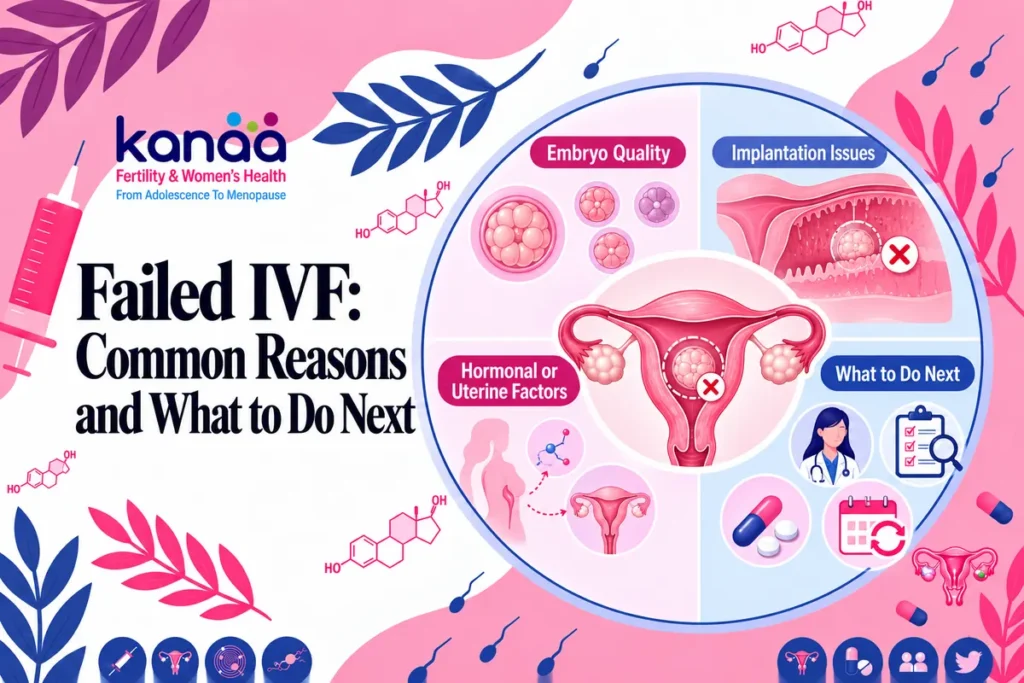
A negative result after IVF can feel crushing, especially after weeks of tests, injections and hope. If you are going through this, please know that your feelings are valid and that one unsuccessful cycle does not decide your future. IVF does not work every time for anyone, and a careful review of the cycle often gives useful information for the next step.
This guide explains why IVF may not succeed, what a cycle review involves, and which options you can discuss with your fertility specialist.

Is an unsuccessful IVF cycle common?
Yes. Even when everything is done well, not every IVF cycle leads to pregnancy. The chance of success in each cycle depends on age, egg and sperm quality, embryo development and the uterus. Many couples need more than one cycle. A failed cycle is a reason to review and adjust the plan, not a sign that pregnancy is impossible.
Possible reasons IVF does not work
Often there is no single clear reason. Doctors look at each stage of the cycle.
| Area | Possible factors | What may be checked |
|---|---|---|
| Embryo | Embryo quality, chromosome changes in the embryo | Embryology report, embryo grades, PGT-A discussion |
| Eggs | Age-related egg quality, low ovarian reserve | AMH, antral follicle count, response to stimulation |
| Sperm | Sperm count, movement, shape or DNA quality | Repeat semen analysis, further sperm tests |
| Uterus | Polyps, fibroids, scarring, thin lining, fluid in the tubes | Ultrasound, SSG, hysteroscopy |
| Hormones and health | Thyroid, blood sugar, weight, smoking | Blood tests, lifestyle review |
| Treatment cycle | Response to medicines, transfer timing | Review of the stimulation and transfer records |
Embryo quality and chromosomes
Many embryos that do not implant have chromosome changes that cannot be seen under a microscope. This becomes more common as a woman gets older. It is not caused by anything you did.
The uterus and implantation
An embryo needs a healthy uterine lining to implant. Polyps, fibroids, adhesions or a blocked tube filled with fluid (hydrosalpinx) can sometimes reduce the chance of implantation.
Egg and sperm factors
Egg quality declines with age, and some women respond less to stimulation medicines. Sperm factors, including DNA quality, can also affect fertilisation and embryo growth.
Failed implantation vs early pregnancy loss
These two situations are different and are investigated differently.
| Failed implantation | Early pregnancy loss | |
|---|---|---|
| What happens | Embryo does not attach, pregnancy test stays negative | Pregnancy test turns positive, then the pregnancy ends |
| Main questions | Embryo quality, uterine lining, transfer factors | Chromosomes, uterus, hormones, clotting and immune factors |
| Related term | Repeated implantation failure | Recurrent miscarriage |
If you have had more than one pregnancy loss, read our guide to recurrent miscarriage.
What is repeated implantation failure?
Repeated implantation failure means that good-quality embryos have been transferred in several IVF cycles without a pregnancy. Definitions differ between guidelines, but they usually consider the number of transfers, embryo quality and the woman’s age. It is a signal to look more closely at the embryos, the uterus and overall health.
Tests your doctor may suggest after a failed cycle
Not everyone needs every test. Your doctor will choose based on your history.
- A detailed review of your stimulation, egg retrieval, embryology and transfer records
- Ultrasound or saline sonography to check the uterine cavity
- Hysteroscopy if a polyp, fibroid or scarring is suspected
- Hormone and thyroid blood tests
- Repeat semen analysis and, in some cases, sperm DNA tests
- Discussion of genetic testing of embryos (PGT-A) in selected cases
- An ERA test in selected cases, to check the timing of the uterine lining
- An endometrial biopsy if inflammation or infection of the lining is suspected
Options for the next attempt
Your plan may include one or more of these, depending on the review:
- A change in stimulation protocol to improve egg numbers or quality.
- ICSI if fertilisation was low in the previous cycle.
- Treating a uterine problem such as a polyp or fibroid before the next transfer.
- Frozen embryo transfer if stored embryos are available, sometimes with a different lining preparation.
- PGT-A in selected cases to help choose embryos for transfer.
- Donor eggs or donor sperm when egg or sperm quality is the main factor, with full counselling.
No option can guarantee pregnancy. Your specialist will explain the realistic benefits and limits of each for your situation.
How long to wait before trying again
Many couples can start another cycle after one or two menstrual cycles, once the body has recovered and the review is complete. Some take longer to rest emotionally or financially, and that is a valid choice.
Should you get a second opinion?
A second opinion can be helpful after more than one unsuccessful cycle, or if you feel your questions have not been fully answered. Bring all your reports, including embryology details, to the consultation.
Looking after yourselves
A failed cycle affects both partners. Give yourselves time to grieve, talk openly, and accept support from people you trust. Fertility counselling can help you process the result and make decisions calmly.
Key points
- One failed IVF cycle is common and does not mean IVF cannot work for you.
- Embryo chromosome changes are a frequent reason implantation does not happen.
- A cycle review checks embryos, eggs, sperm, the uterus and health factors.
- Next-step options include protocol changes, treating uterine problems, FET, PGT-A and donor programmes.
- Take the time you need before trying again.
Review your IVF cycle with Kanaa Fertility
If your IVF cycle was not successful, at Kanaa Fertility or elsewhere, our specialists in KK Nagar and Mylapore, Chennai, can review your reports and talk you through your options. Book a cycle review consultation.
Frequently Asked Questions
Why did my IVF fail with good embryos?
Even good-looking embryos can have chromosome changes that are not visible under a microscope. Uterine factors and timing can also play a role. A cycle review helps look for possible reasons.
What should I do after a failed IVF cycle?
Take time to recover, then book a review with your fertility specialist. They will go through your records, suggest any tests, and explain the options for the next attempt.
How soon can I try IVF again after a failed cycle?
Many couples can start again after one or two menstrual cycles, but timing depends on your health, the tests needed and your readiness. Your doctor will advise.
What tests are done after failed IVF?
Tests may include a uterine cavity check, hysteroscopy, hormone and thyroid tests, a repeat semen analysis and a discussion of embryo genetic testing, depending on your history.
Is it worth trying IVF again after failure?
For many couples, yes. A failed cycle often gives information that helps adjust the next plan. Your specialist can explain your realistic chances based on your age and test results.
What is the difference between failed implantation and miscarriage?
In failed implantation, the pregnancy test stays negative. In a miscarriage, the pregnancy test turns positive and the pregnancy then ends. They are investigated differently.