
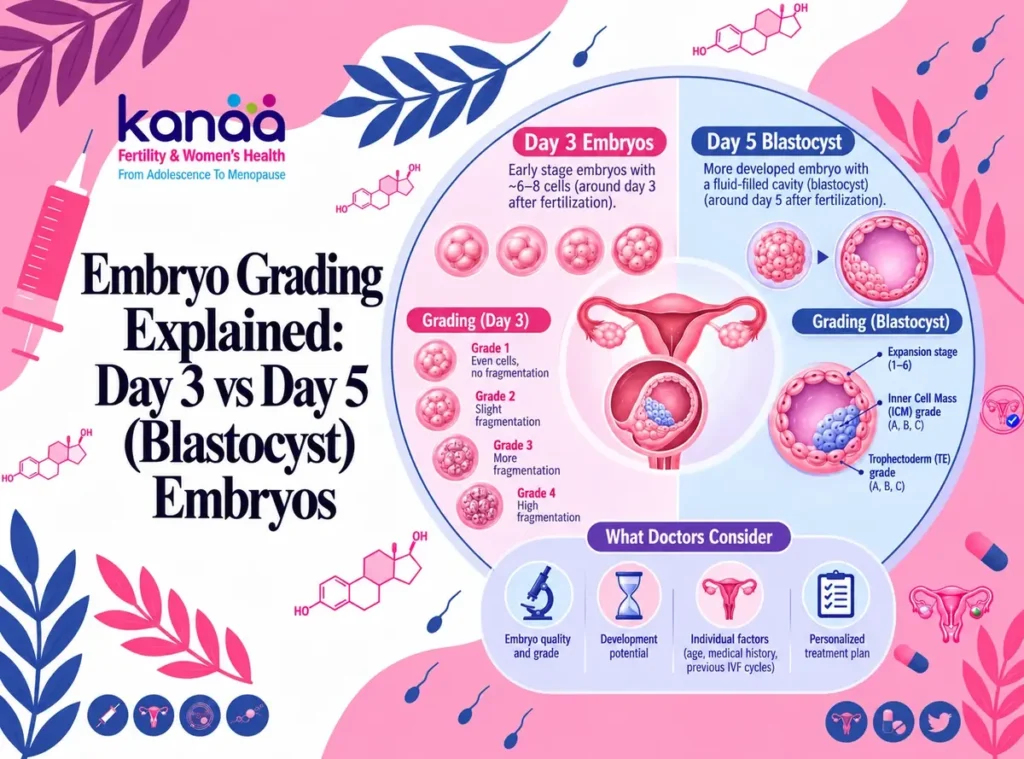
During IVF, you may receive updates such as “you have two 8-cell embryos” or “one 4AA blastocyst”. These grades can feel like a code. Understanding them can help you follow your treatment and ask clearer questions. You can also follow the full IVF timeline.
This guide explains how embryos are graded on day 3 and day 5, what the letters and numbers mean, and why grades are only one part of the picture. Your embryologist and doctor will explain your own embryo report.

What is embryo grading?
Embryo grading is a way for embryologists to describe how an embryo looks under a microscope at a set point in its development. It considers features such as the number and evenness of cells, fragmentation, and on day 5 how well the blastocyst has expanded. Grades help choose which embryo to transfer or freeze, but they do not guarantee or rule out pregnancy.
How an embryo develops from day 1 to day 5
| Day | Stage | What is happening |
|---|---|---|
| Day 1 | Fertilised egg (zygote) | Egg and sperm have joined; fertilisation is checked |
| Day 2 | 2 to 4 cells | First cell divisions |
| Day 3 | Cleavage stage, often 6 to 8 cells | Cells keep dividing |
| Day 4 | Morula | Cells compact into a ball |
| Day 5 to 6 | Blastocyst | A fluid-filled cavity forms with two cell groups |
Not every embryo reaches the blastocyst stage. This is a normal part of embryo development in the lab and in nature.
Day 3 embryo grading
On day 3, embryologists usually look at three features.
- Cell number. Around 6 to 8 cells is typical for day 3.
- Symmetry. Whether the cells are of similar size.
- Fragmentation. Small pieces of cell material that have broken off. Less fragmentation is generally preferred.
A day 3 embryo may be described as, for example, “8-cell, grade 1”. Grading scales differ between clinics, so ask how your clinic’s scale works.
Blastocyst grading on day 5
Many clinics use a three-part grade for blastocysts, such as 4AA or 3BB.
| Part of the grade | What it describes | Scale |
|---|---|---|
| Number (1 to 6) | How expanded the blastocyst is | 1 is early, 4 is fully expanded, 5 and 6 are hatching or hatched |
| First letter (A, B, C) | Inner cell mass, the cells that may form the baby | A has many tightly packed cells, C has few |
| Second letter (A, B, C) | Trophectoderm, the cells that may form the placenta | A has many cells forming a smooth layer, C has few |
So a “4AA” blastocyst is fully expanded, with a well-formed inner cell mass and outer layer. A “3BB” blastocyst is expanded, with good but slightly fewer cells in each group.
What if my blastocyst has a lower grade?
Lower-grade blastocysts can and do lead to healthy pregnancies. Grades describe appearance, not genetics. Your doctor will consider grade alongside your age and history when choosing an embryo.
Day 3 vs day 5 embryo transfer
Day 3 transfer places a cleavage-stage embryo in the uterus, while day 5 transfer places a blastocyst. Waiting until day 5 lets the embryologist see which embryos keep developing, which can help with selection. Day 3 transfer may be chosen when there are few embryos or for other clinical reasons. Your doctor recommends the timing for your cycle.
| Factor | Day 3 transfer | Day 5 (blastocyst) transfer |
|---|---|---|
| Embryo stage | 6 to 8 cells | Blastocyst with inner cell mass and outer layer |
| Time in the lab | Shorter | Longer |
| Selection information | Less, because development is still early | More, because only some embryos reach day 5 |
| When it may be chosen | Few embryos, or specific clinical reasons | Several good embryos, single embryo transfer, genetic testing |
| Possible downside | Less information to choose from | Some embryos may not reach day 5, so there may be none to transfer |
What grades can and cannot tell you
- Grades help rank embryos from the same cycle.
- Grades are a snapshot at one moment.
- Grades do not show whether an embryo has normal chromosomes.
- A higher grade is linked with better chances on average, but it is not a promise.
- A lower grade does not mean an embryo cannot lead to pregnancy.
Embryo grading vs PGT-A
Embryo grading looks at how an embryo appears. PGT-A (preimplantation genetic testing for aneuploidy) checks a few cells for the correct number of chromosomes. They answer different questions. PGT-A is suggested only in selected situations, and your doctor will explain whether it may help you.
Grading and frozen embryos
Embryos are usually graded before freezing. Frozen embryos are checked again after thawing to see that they have survived and re-expanded before transfer.
How Kanaa Fertility reports embryo grades
At Kanaa Fertility, our embryology team shares an update on embryo development during your cycle and explains the grades in simple words.
Key points
- Embryo grading describes how an embryo looks at a set stage.
- Day 3 grading uses cell number, symmetry and fragmentation.
- Blastocyst grades like 4AA combine expansion, inner cell mass and outer layer.
- Grades help choose embryos but cannot guarantee or rule out pregnancy.
- Day 3 or day 5 transfer is chosen for your individual cycle.
Discuss your embryo report with our team
If you have questions about your embryo grades or transfer plan, the IVF team at Kanaa Fertility in KK Nagar and Mylapore, Chennai, can walk you through your report. Book a consultation.
Frequently Asked Questions
What is a good blastocyst grade?
Blastocysts graded 3 or above with A or B letters, such as 4AA, 4AB or 3BB, are generally considered good quality. Lower grades can still lead to pregnancy.
What does 4AA mean in embryo grading?
4AA describes a fully expanded blastocyst with a tightly packed inner cell mass (A) and a well-formed outer layer of cells (A).
Is a day 5 transfer better than a day 3 transfer?
Neither is better for everyone. Day 5 transfer gives more information for choosing an embryo, while day 3 may suit cycles with few embryos. Your doctor decides for your cycle.
Can a low-grade embryo result in pregnancy?
Yes. Lower-grade embryos can lead to healthy pregnancies. Grades describe appearance and are only one factor.
Why did my embryos stop growing before day 5?
It is common for some embryos to stop developing, often because of chromosome changes. It does not mean you did anything wrong. Your doctor can review your cycle.
Does embryo grading check for genetic problems?
No. Grading looks at appearance only. Checking chromosomes needs genetic testing such as PGT-A.