
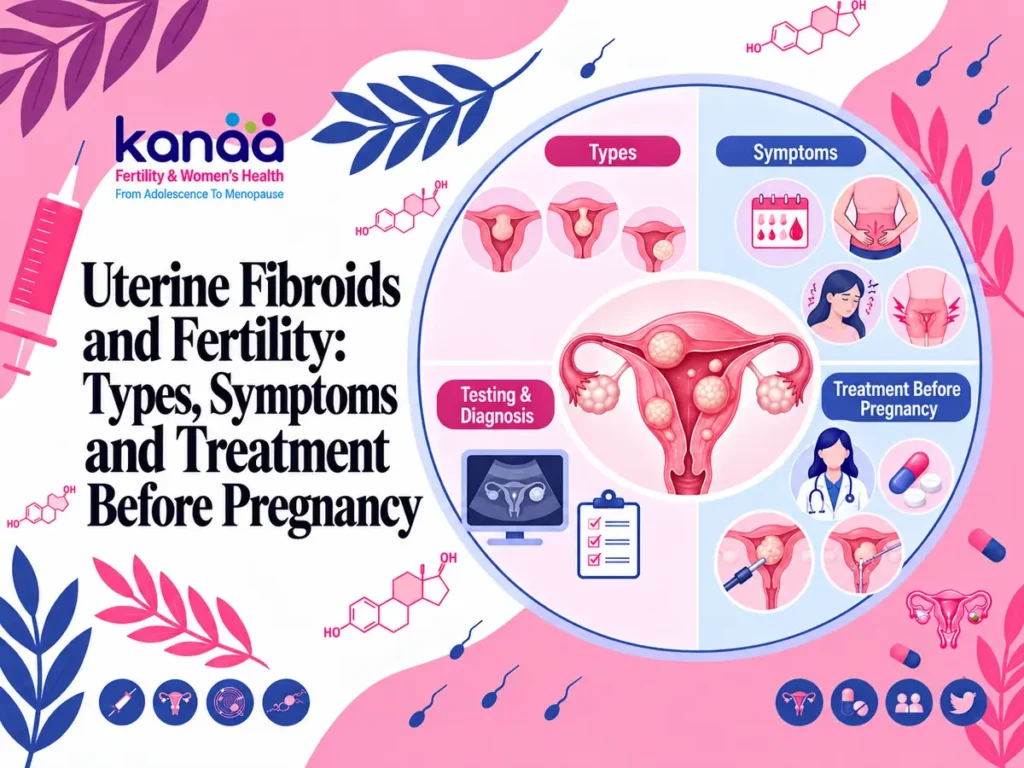
Many women first hear the word “fibroid” on a routine ultrasound report. If you are planning a pregnancy, it is natural to worry about what it means. The good news is that fibroids are common, they are not cancer, and many women with fibroids conceive without any treatment. Whether a fibroid matters for fertility depends mostly on where it sits and how big it is.
This guide explains the types of fibroids, how they can affect getting pregnant, and when treatment may be suggested. Your own plan depends on a scan review and a medical evaluation.
What are uterine fibroids?
Uterine fibroids are non-cancerous growths of muscle tissue in or on the wall of the uterus. They range from very small to several centimetres in size. Many cause no symptoms. Fibroids can affect fertility when they change the shape of the uterine cavity, block the fallopian tubes, or are large enough to affect the uterine lining.
Doctors also call fibroids myomas or leiomyomas. They are most common between the ages of 30 and 50 and often grow in response to oestrogen.
Types of fibroids and how each may affect fertility
The location of a fibroid matters more than the number of fibroids.
| Type | Where it grows | Possible effect on fertility | Usual approach when trying to conceive |
|---|---|---|---|
| Submucosal | Bulges into the uterine cavity | Most likely to affect implantation and pregnancy | Often removed through hysteroscopy before trying or before IVF |
| Intramural | Inside the muscle wall | May matter if large or if it distorts the cavity | Decided case by case after imaging |
| Subserosal | On the outer surface of the uterus | Usually little or no effect on fertility | Often left alone unless causing symptoms |
| Pedunculated | Attached by a stalk, inside or outside | Depends on location | Decided case by case |
Can fibroids cause infertility?
Fibroids can contribute to infertility, especially submucosal fibroids that press into the uterine cavity. They are rarely the only reason a couple has difficulty conceiving. Many women with small fibroids outside the cavity get pregnant naturally. A full fertility assessment of both partners helps show whether the fibroid is likely to be a factor.
How fibroids can interfere
- Changing the shape of the uterine cavity, which can affect embryo implantation
- Affecting blood flow to the uterine lining
- Blocking the opening of a fallopian tube, in rare cases
- Causing heavy bleeding that leads to anaemia
Symptoms of fibroids
Many women have no symptoms at all. When symptoms occur, they can include:
- Heavy or long periods
- Pelvic pressure or a feeling of fullness in the lower abdomen
- Needing to pass urine often
- Pain during periods or during intercourse
- Tiredness from blood loss
These symptoms can have other causes too, so a scan is needed to confirm fibroids.
How fibroids are diagnosed
| Test | What it shows | When it is used |
|---|---|---|
| Transvaginal ultrasound | Number, size and position of fibroids | First test in most cases |
| Saline sonography (SSG) | Whether a fibroid bulges into the cavity | When the cavity needs a closer look |
| Hysteroscopy | Direct view inside the uterus | To confirm and often treat submucosal fibroids |
| MRI | Detailed map of multiple or large fibroids | Selected cases, before surgery |
Can you get pregnant with fibroids?
Yes, many women do. Whether fibroids need attention before pregnancy depends on:
- Their type and position, especially any contact with the cavity
- Their size and number
- Your age and ovarian reserve
- How long you have been trying and any previous pregnancy losses
- Whether you are planning natural conception, IUI or IVF
Treatment options before trying to conceive
Watchful waiting
Small fibroids outside the cavity, with no symptoms, are often simply monitored.
Hysteroscopic myomectomy
A thin camera is passed through the cervix to remove fibroids inside the cavity. There are no cuts on the abdomen, and recovery is usually quick.
Laparoscopic or open myomectomy
Fibroids in or on the wall can be removed through small keyhole cuts (laparoscopy) or, for larger or multiple fibroids, an open operation. Your surgeon will explain which approach suits you.
Medicines
Some medicines can reduce bleeding or shrink fibroids for a time, but most are not used while trying to conceive. Your doctor will explain what is suitable for you.
Fibroids and IVF
Before IVF, your doctor will check whether any fibroid touches or distorts the cavity. Submucosal fibroids are often removed first. Fibroids outside the cavity may not need surgery. The decision balances the possible benefit against surgical recovery time and your age.
Trying to conceive after fibroid surgery
The waiting time depends on the type of surgery. After hysteroscopic removal, the wait is often short. After surgery on the uterine wall, a longer wait is usually advised so the uterus can heal, and your doctor may discuss how you will deliver in a future pregnancy. Always follow your surgeon’s advice on timing.
When to see a fertility specialist
- Your scan shows a fibroid and you plan to conceive soon
- You have heavy periods and have been trying for 6 to 12 months
- You have had a pregnancy loss and fibroids were seen on a scan
- You are preparing for IVF and have a known fibroid
Key points
- Fibroids are common and non-cancerous.
- Submucosal fibroids are the type most likely to affect fertility.
- Many fibroids do not need treatment before pregnancy.
- Hysteroscopy can often remove cavity fibroids without abdominal cuts.
- The right plan depends on your scan, age and fertility goals.
Get your scan reviewed at Kanaa Fertility
If your ultrasound mentions a fibroid, our fertility specialists at Kanaa Fertility in KK Nagar and Mylapore, Chennai, can explain what it means for your pregnancy plans and whether any treatment is needed. Book a consultation and bring your scan reports.
Frequently Asked Questions
Can fibroids cause infertility?
Fibroids can contribute to infertility, mainly when they press into the uterine cavity. Many women with small fibroids outside the cavity conceive without treatment.
Which type of fibroid affects pregnancy the most?
Submucosal fibroids, which bulge into the uterine cavity, are the type most likely to affect implantation and pregnancy.
Should fibroids be removed before IVF?
Fibroids that distort the uterine cavity are often removed before IVF. Fibroids outside the cavity may not need surgery. Your doctor decides after reviewing your scans.
Can I get pregnant naturally with fibroids?
Yes. Many women with fibroids conceive naturally, especially when the fibroids are small and outside the cavity.
How long after fibroid removal can I try to conceive?
It depends on the surgery. The wait is often short after hysteroscopic removal and longer after surgery on the uterine wall. Follow your surgeon’s advice.
Do fibroids grow during pregnancy?
Some fibroids grow during pregnancy because of hormone changes, while others stay the same size. Your doctor will monitor them with scans.