
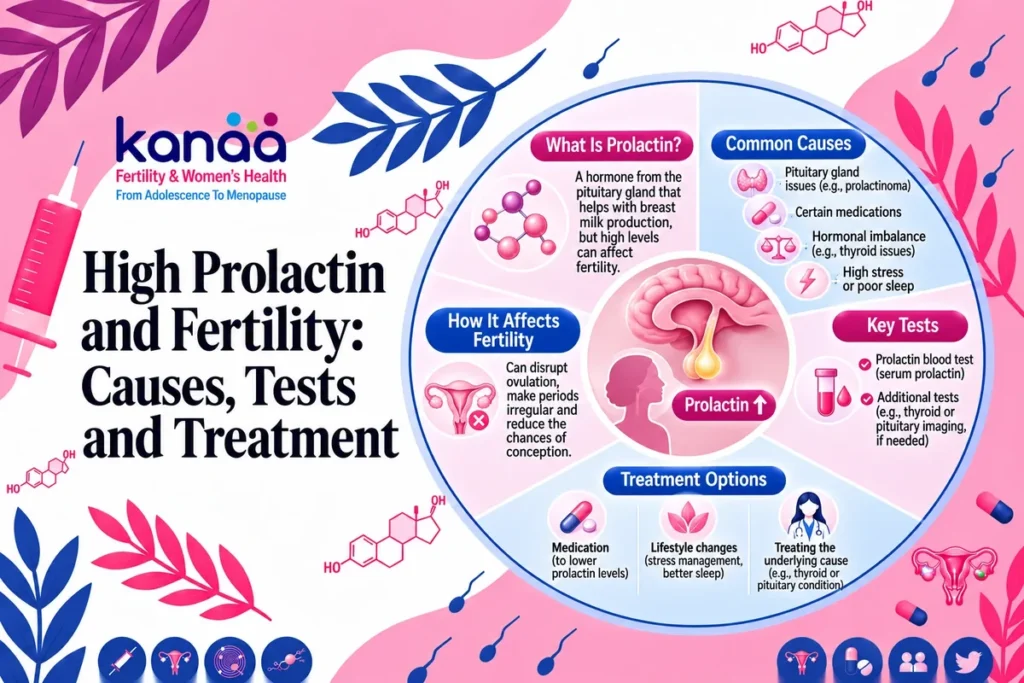
High prolactin, called hyperprolactinaemia, is a raised level of the hormone prolactin in the blood. It can disturb ovulation and periods in women and lower sex drive and sperm production in men, which can make it harder to conceive. Common causes include certain medicines, an underactive thyroid, stress and small non-cancerous pituitary growths. Once the cause is treated, ovulation often returns.
Many women first hear the word prolactin when a blood test comes back high during a fertility check. It can be worrying, especially if the report uses unfamiliar terms. In most cases high prolactin has a clear cause and responds well to treatment. This guide explains what prolactin does, why it rises, how it is tested and what treatment looks like when you are trying to conceive.
What is prolactin?
Prolactin is a hormone made by the pituitary gland, a small gland at the base of the brain. Its main job is to stimulate milk production after childbirth. Levels rise naturally during pregnancy and breastfeeding.
Outside pregnancy and breastfeeding, prolactin levels are normally low. Both women and men produce it.
How does high prolactin affect fertility?
When prolactin is high, it suppresses the brain hormone that controls the reproductive system. This lowers the signals that tell the ovaries to grow and release an egg, or the testes to make testosterone and sperm.
In women
- Ovulation may become irregular or stop. Read about anovulation.
- Periods may become irregular, light or absent.
- The second half of the cycle may be shortened, which can affect implantation.
In men
- Testosterone may fall.
- Sex drive and erections may be affected.
- Sperm production may be reduced.
Signs of high prolactin
Some people have no symptoms and high prolactin is found only on a blood test. When symptoms occur, they may include:
Women
- Irregular, infrequent or absent periods
- Difficulty getting pregnant
- Milky discharge from the nipples when not pregnant or breastfeeding (galactorrhoea)
- Vaginal dryness or discomfort during intercourse
- Low sex drive
Men
- Low sex drive
- Difficulty with erections
- Breast enlargement
- Reduced facial or body hair over time
Signs that need prompt attention
If high prolactin comes with persistent headaches or changes in vision, such as loss of side vision, see a doctor promptly. These can be signs of a larger pituitary growth pressing on nearby structures. This is uncommon.
Common causes of high prolactin
Natural causes
- Pregnancy and breastfeeding
- Physical or emotional stress, including stress from the blood test itself
- Recent sleep, intense exercise, or nipple stimulation before the test
Medicines
Several types of medicines can raise prolactin, including some used for mental health, nausea, acid reflux and high blood pressure. Never stop a prescribed medicine on your own. Tell your fertility doctor about every medicine and supplement you take, so they can work with the prescribing doctor if needed.
Thyroid problems
An underactive thyroid (hypothyroidism) can raise prolactin. Treating the thyroid often brings prolactin back to normal. This is why thyroid tests are usually checked alongside prolactin. Read thyroid and fertility.
Pituitary causes
A small, non-cancerous growth in the pituitary gland, called a prolactinoma, can produce extra prolactin. Most are very small (microprolactinomas) and respond well to medicine. Larger ones are less common.
Other causes
- Polycystic ovary syndrome (PCOS), in some women
- Kidney or liver disease
- Chest wall injury or surgery, or conditions such as shingles affecting the chest
- Macroprolactin: a larger, mostly inactive form of prolactin that can make results look high without causing symptoms
In some people, no cause is found. This is called idiopathic hyperprolactinaemia.
How is prolactin tested?
Prolactin is checked with a simple blood test, often as part of a female fertility test or a male fertility assessment.
Getting an accurate result
Because prolactin rises with stress and activity, timing matters:
- The test is often done in the morning, a few hours after waking.
- Rest quietly for a short time before the sample is taken.
- Avoid breast or nipple stimulation and intense exercise beforehand.
- Tell the team about any medicines you take.
If the result is high
A mildly high result is often repeated before any decision is made. Your doctor may also check:
- Thyroid function (TSH)
- A pregnancy test
- Kidney and liver function
- Macroprolactin, if symptoms do not match the result
- An MRI scan of the pituitary gland, if prolactin stays clearly high without another explanation
Prolactin results and what they may mean
| Finding | Possible meaning | Usual next step |
|---|---|---|
| Mildly high, no symptoms | Stress, timing or macroprolactin | Repeat the test under resting conditions |
| High with irregular periods | Prolactin affecting ovulation | Find the cause; treat if confirmed |
| High with low thyroid function | Hypothyroidism | Treat the thyroid, then recheck |
| High while on certain medicines | Medicine effect | Review with the prescribing doctor |
| Persistently high, no clear cause | Possible prolactinoma | Pituitary MRI and specialist review |
Treatment options
Treatment depends on the cause, the prolactin level, your symptoms and whether you are trying to conceive.
Treating the underlying cause
- Correcting an underactive thyroid
- Reviewing medicines that raise prolactin, with the prescribing doctor
- Managing stress and repeating the test if the first result was borderline
Medicines that lower prolactin
The main treatment for a prolactinoma, or for high prolactin without a reversible cause, is a group of medicines called dopamine agonists. They lower prolactin and often shrink a prolactinoma. In many women, periods and ovulation return within a few months of treatment. Your doctor will choose the medicine and dose, check levels regularly and explain possible side effects, such as nausea or dizziness.
Surgery
Surgery on the pituitary gland is rarely needed. It may be considered when medicines are not tolerated or do not work, or for large growths causing pressure symptoms.
Fertility treatment
If ovulation does not return after prolactin is controlled, or if there are other fertility factors, your doctor may suggest ovulation induction, IUI or IVF. See types of fertility treatment.
Trying to conceive with high prolactin
- Many women conceive naturally once prolactin is back in the normal range and ovulation returns.
- Track your cycles. Regular periods are a good sign that ovulation has resumed. See how to tell when you are ovulating.
- Tell your doctor as soon as your pregnancy test is positive. They will advise whether to continue or stop prolactin-lowering medicine, which depends on your situation.
- Women with a larger prolactinoma need closer monitoring in pregnancy.
- Make sure your partner is also tested, as male factors are common.
If you have been diagnosed with PCOS or thyroid disease as well, your doctor will plan treatment for all conditions together.
High prolactin, PCOS and thyroid problems: how they differ
All three conditions can cause irregular periods and difficulty conceiving, so they are often tested together. The difference lies in the cause and the treatment.
| Condition | What happens | Typical clues | Main treatment approach |
|---|---|---|---|
| High prolactin | Raised prolactin suppresses the signals that trigger ovulation | Irregular or absent periods, sometimes nipple discharge | Treat the cause or lower prolactin with medicine |
| PCOS | Hormone imbalance affects egg development and release | Irregular periods, acne, excess hair growth, multiple small follicles on scan | Lifestyle changes, ovulation induction |
| Underactive thyroid | Low thyroid hormone slows metabolism and can raise prolactin | Tiredness, weight gain, feeling cold, heavier periods | Thyroid hormone treatment |
Because an underactive thyroid can itself raise prolactin, doctors usually correct the thyroid first and then recheck prolactin before starting other treatment.
High prolactin and IVF
High prolactin does not usually prevent IVF, but doctors prefer to bring it under control first. Raised prolactin can affect how the ovaries respond and may affect the uterine lining. If you are preparing for IVF and your prolactin is high, your doctor may repeat the test, treat the cause and plan the cycle once the level is stable. Read our IVF process step by step guide to see where hormone tests fit in.
Questions to ask your doctor
- Was my test done under resting conditions, and should it be repeated?
- Could any of my medicines be raising my prolactin?
- Is my thyroid normal?
- Do I need an MRI scan?
- How long will treatment take, and how will we know it is working?
- When can we start trying to conceive, or start fertility treatment?
- What should I do if I become pregnant while on treatment?
Living with high prolactin
For most people, high prolactin is a manageable condition. Regular follow-up blood tests show whether treatment is working. Keep a simple record of your periods, any symptoms and your test results to share at each visit. Stress management, regular sleep and a balanced routine support overall hormonal health, though they do not replace medical treatment when it is needed.
Common myths about high prolactin
- “High prolactin means a brain tumour.” Most cases have simpler causes such as stress, medicines or thyroid problems. When a prolactinoma is found, it is non-cancerous and usually small.
- “One high result confirms the diagnosis.” A mildly high result is often repeated, because stress and timing can raise prolactin temporarily.
- “Only women get high prolactin.” Men can have it too, and it can affect their fertility.
- “Treatment means I can never get pregnant naturally.” Many women ovulate and conceive naturally once prolactin is controlled.
Frequently asked questions
Can high prolactin stop periods?
Yes. High prolactin can suppress ovulation, which can make periods irregular, light or stop altogether. Periods often return once prolactin is brought back to normal.
Can I get pregnant with high prolactin?
It can be harder while prolactin is high, because ovulation may not happen regularly. Once the level is treated, many women ovulate and conceive.
Can men have high prolactin?
Yes. In men it can lower testosterone, sex drive, erections and sperm production. It is checked as part of a male fertility assessment when needed.
Is high prolactin permanent?
Often not. When the cause is a medicine, stress or thyroid problem, levels usually return to normal once it is addressed. Prolactinomas usually respond well to medicine, though treatment may be needed for a longer time.
Does stress raise prolactin?
Yes, physical and emotional stress can raise prolactin temporarily. This is why a mildly high result is usually repeated under resting conditions.
Is a prolactinoma a cancer?
No. A prolactinoma is a non-cancerous growth of the pituitary gland. Most are small and respond well to treatment.
Book a hormone and fertility check
Kanaa Fertility Centre checks prolactin, thyroid and other fertility hormones as part of our tests for women and men at our centres in KK Nagar and Mylapore, Chennai. If your periods are irregular or a report shows high prolactin, book a fertility test for women or contact us to speak with our team.
This article is for general information. Every couple is different, and your doctor will recommend tests and treatment based on your individual evaluation.