Frozen embryo transfer is the process of placing embryos — frozen during an earlier IVF or ICSI cycle — into your uterus in a later, carefully prepared month. Available at our KK Nagar and Mylapore clinics in Chennai.
Talk to a Kanaa fertility specialist. We will call you back.
Request a CallbackYour enquiry is private and handled with care by our medical team.
Frozen embryo transfer at Kanaa Fertility places embryos — frozen during an earlier IVF or ICSI cycle — into your uterus in a later, carefully prepared month, once your lining is at its most receptive. Two clinics in KK Nagar & Mylapore, with in-person & online consultations.
Embryos formed and frozen during an earlier IVF or ICSI cycle, replaced in your uterus once your body and lining are ready.
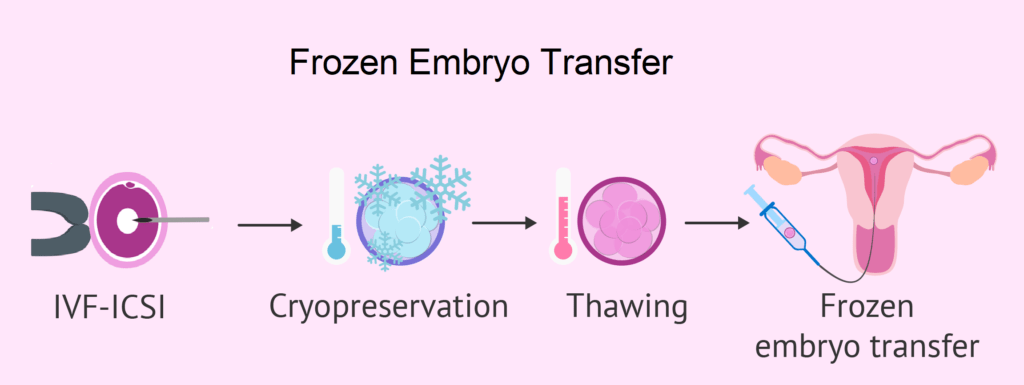
This is the name given to the process in which embryos formed and frozen in an IVF cycle are replaced in the uterus in a subsequent month. Rather than transferring an embryo in the same cycle it was created, freezing allows your specialist to choose the timing that gives it the best chance.
Your lining is monitored and prepared before transfer, not left to chance.
Many clinics now prefer FET over fresh transfer for several reasons.
Extra embryos from a previous cycle are not wasted; they can be used in future attempts.

Embryos are frozen using a fast-freezing technique that protects them during storage, and carefully thawed when it is time for your transfer.
Embryos are frozen shortly after they are formed, preserving them for future use.
Frozen embryos are stored securely until you are ready for transfer.
Embryos are thawed shortly before your transfer, and checked for survival.
A small number of embryos may not survive the freeze-thaw process — this is uncommon, but honest to mention upfront.
Every step is explained to you as we go — you will always know how your embryo is being cared for.
FET is considered in several different situations — your specialist will explain which applies to you:
When embryos from an earlier IVF or ICSI cycle were frozen for future use.
When your specialist recommends freezing all embryos and transferring later, often to reduce OHSS risk or optimise timing.
When embryos are tested for genetic conditions before being transferred.
Most donor treatment pathways end with a frozen embryo transfer.
When your specialist recommends waiting for the right timing or your body’s readiness.
Not sure if it is right for you? A consultation is the clearest way to find out.
A clear, step-by-step path — every protocol personalised to you.
You are seen on day 1 or 2 of your period to begin monitoring.
A transvaginal scan confirms the absence of any cysts before starting.
Medication may be started if you are having a hormone replacement (HRT) cycle.
Ultrasound monitoring of your uterine lining begins around day 10 of your cycle.
Once your lining reaches a satisfactory thickness, progesterone is started.
Embryo transfer is planned 3–5 days after starting progesterone, depending on whether day 3 or day 5 embryos are being used.
Transfer is done under ultrasound guidance.
Injections or medicines support this phase for about two weeks.
A beta hCG blood test is taken 12–14 days after transfer.
Success with FET depends on embryo quality, your endometrial lining, and your individual diagnosis — so no honest clinic can promise a single number for everyone. What we can promise is realistic, transparent guidance based on your own situation, and a clear conversation about your chances before you begin.
How well the embryo survived freezing and thawing affects its chance of implanting.
We usually look for a minimum of 8mm thickness before transfer.
Success relates to the age you were when the eggs were originally collected, not necessarily your current age.
Natural cycle vs hormone replacement (HRT) cycle protocols can each suit different situations.
Weight, smoking, alcohol and stress all play a role — and many are within your control.
Your specialist reviews all of these together to give you an honest, personalised picture.
Fertility care that combines medical expertise, careful monitoring, and compassionate support.
A skilled team specialised in reproductive medicine.
Scans and dose adjustments guided at every step.
Your treatment designed around your body and diagnosis.
Support at every step of your journey.
KK Nagar & Mylapore, with flexible scheduling.
These are two approaches to the same step — the right one depends on your situation. Your specialist recommends whichever gives you the best realistic chance.
Embryos are transferred in the same cycle they were created, without freezing.
Embryos are frozen after creation and transferred in a later, carefully prepared cycle — often once your body has recovered from stimulation medicines and your lining is optimally timed.
FET is increasingly preferred because it allows more precise timing — your specialist will explain why it might be recommended for you.
This is exactly why we monitor so closely — your scans and hormone levels let us adjust as we go. Please call us any time you are unsure, or if anything does not feel right.
Bring these to your consultation — we welcome open, honest conversations.
Book a consultation at Kanaa Fertility, Chennai — KK Nagar & Mylapore. Honest, personalised guidance at every step.